Key takeaways
- Diversification goes beyond holding multiple Investment Notes. Spreading capital across different Issuers, risk grades, business sectors and tenors can help reduce concentration risk. Each dimension addresses a different source of exposure within a P2P investment portfolio.
- Diversification does not eliminate investment risk. P2P Investment Notes are not protected by Perbadanan Insurans Deposit Malaysia (PIDM) or the Capital Market Compensation Fund (CMCF). Investors remain exposed to the risk of delayed repayments, default and potential loss of capital, regardless of how widely their investments are spread.
- Tenor diversification helps manage repayment timelines, not liquidity. P2P Investment Notes cannot be withdrawn on demand, and invested funds generally remain committed until maturity. Holding Notes with different tenors can stagger expected repayment dates, but it does not provide early access to invested capital.
- A small starting amount can support diversification. On microLEAP, Investors can invest from RM10 per Investment Note, making it possible to spread capital across multiple Notes without committing a large amount to each investment.
- Auto-Invest can help implement a diversification strategy. The feature automatically allocates funds to Investment Notes that match an Investor’s selected criteria, subject to availability and applicable conditions. However, allocation is not guaranteed, and automation does not eliminate investment risk or guarantee returns.
Introduction
For Investors new to P2P financing, it can be tempting to concentrate most or all of their available funds in one or two Investment Notes. However, this approach increases portfolio concentration risk, as the performance of a single Issuer can have a disproportionate impact on overall investment outcomes. If an Issuer delays repayment or defaults, the consequences may extend beyond the individual Investment Note to affect the portfolio as a whole.
microLEAP is registered with the Securities Commission Malaysia (SC) as a Recognised Market Operator (RMO) to operate a peer-to-peer (P2P) financing platform. On the platform, businesses seeking financing are referred to as Issuers, and Investors provide funding through Investment Notes.
This article explores the role of diversification in managing P2P investment risk, the key dimensions Investors should consider when spreading their investments, and how microLEAP’s Auto-Invest feature can support a diversification strategy. It also examines the limitations of diversification and why spreading investments across multiple Notes does not eliminate the risk of loss.
For an overview of common pitfalls faced by new Investors, including the risks of concentrating funds in a single Investment Note, see P2P Investing for First-Time Investors: Common Mistakes to Avoid.
Why does diversification matter in P2P investing?
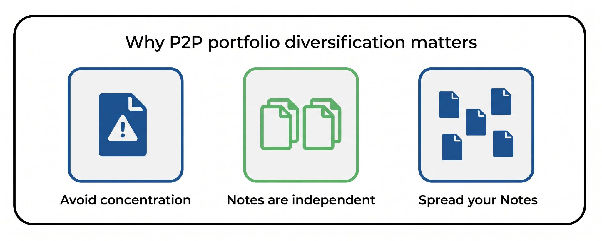
Image: Why spreading P2P investments across multiple Notes reduces concentration risk.
Diversification is an important risk-management consideration in P2P investing because each Investment Note carries its own credit risk. If an Issuer defaults, Investors may lose part or all of the capital invested in that Note. When a substantial portion of a portfolio is concentrated in one Investment Note, the impact of a single default can be disproportionately large.
Spreading investments across multiple Investment Notes helps reduce reliance on any single Issuer’s repayment performance. If one Issuer experiences financial difficulties, the impact on the overall portfolio may be more limited, provided the remaining investments continue to perform as expected. However, diversification does not guarantee that other Notes will remain unaffected by broader economic or sector-specific challenges.
Investors should also recognise that P2P Investment Notes are not bank deposits and are not protected by Perbadanan Insurans Deposit Malaysia (PIDM), the Capital Market Compensation Fund (CMCF) or any deposit insurance scheme. The risk of delayed repayments, default and loss of capital remains, regardless of how many Investment Notes an Investor holds.
On microLEAP, Investors can invest from RM10 per Investment Note, making it practical to spread capital across multiple Notes without requiring a large initial investment in each one.
Ultimately, the objective of diversification is to reduce concentration risk and limit the potential impact of any single Issuer defaulting on the overall portfolio. It is a risk-management strategy, not a guarantee against investment losses.
What should you diversify across in P2P investing?
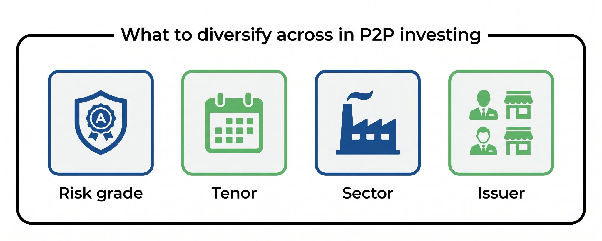
Image: The four dimensions to diversify across in P2P investing on microLEAP.
Effective diversification in P2P financing goes beyond investing in multiple Investment Notes. Investors should consider spreading their capital across four key dimensions: risk grades, tenors, business sectors and Issuers. This approach can help mitigate concentration risk and reduce overexposure to any single category of credit risk, contributing to a more balanced investment portfolio.
Diversifying across risk grades in P2P investing
microLEAP classifies Investment Notes into three risk bands based on its credit assessment, with each band reflecting a different level of assessed credit risk and potential returns:
- Low Risk (LR1-LR3): Generally associated with lower assessed credit risk and lower stated potential returns.
- Medium Risk (MR4-MR7): Generally associated with moderate assessed credit risk and moderate stated potential returns.
- High Risk (HR8-HR10): Generally associated with higher assessed credit risk and higher stated potential returns.
Concentrating investments within a single risk band may increase a portfolio’s exposure to similar credit risks. By diversifying across different risk grades, Investors can spread their exposure across varying levels of assessed credit risk, while taking into account their individual risk tolerance and return expectations.
It is important to note that risk grades are indicators of assessed credit risk, not guarantees of repayment. An Investment Note classified as Low Risk is not risk-free, and all Investment Notes remain subject to the risk of delayed repayments, default and potential loss of capital.
Ultimately, diversification is not about pursuing the highest profit rate or adhering to a fixed allocation across risk bands. Rather, it is about understanding the distribution of credit risk within a portfolio and ensuring that investment decisions remain aligned with the Investor’s financial objectives and risk appetite.
For a more detailed explanation of how risk grades work on P2P financing platforms, see Understanding Credit Ratings on P2P Platforms in Malaysia.
Diversifying across tenors in P2P investing
Tenors vary by financing product and are specified in each Investment Note. They determine how long capital is committed before repayment is due, making tenor an important consideration in portfolio diversification.
Concentrating investments in longer-tenor Investment Notes may limit access to capital for extended periods. By spreading investments across shorter and longer tenors, Investors can stagger their expected repayment schedules, potentially creating more regular opportunities to reinvest funds as repayments are received.
Tenor diversification therefore influences not only investment returns, but also the timing of cash flows and the availability of capital for future investment opportunities. However, actual repayment timing may vary, and funds may not be returned as scheduled if repayments are delayed or an Issuer defaults.
For a closer look at how tenor influences P2P investment returns, see What Affects Your P2P Investment Returns? Tenor, Risk Grade & Repayment.
Diversifying across sectors in P2P investing
Investment Notes on microLEAP span a range of business sectors, including Engineering & Construction, Trading, Services, Manufacturing and Retail, among others. Each sector faces distinct market dynamics, operating conditions and economic challenges that can influence an Issuer’s ability to meet its repayment obligations.
Concentrating investments in a single sector may leave a portfolio more vulnerable to industry-specific headwinds. By diversifying across sectors, Investors can reduce their reliance on the performance of any one industry and mitigate the impact of sector-specific downturns on their overall portfolio.
Sector diversification is not about predicting which industries will perform best. Rather, it is about managing concentration risk by spreading exposure across businesses operating in different economic environments. However, diversification across sectors does not eliminate investment risk, as broader economic conditions may affect multiple industries simultaneously.
Diversifying across Issuers in P2P investing
Even within the same risk grade and business sector, each Issuer presents its own credit risk, shaped by factors such as its financial position, cash flow and ability to meet repayment obligations. Spreading investments across multiple Issuers can reduce reliance on any single business and limit the impact of an individual Issuer’s default on the overall portfolio.
For example, an Investor allocating RM5,000 across 10 Investment Notes of RM500 each would have a more distributed exposure than an Investor placing the entire RM5,000 in a single Investment Note. While this approach can help reduce concentration risk, the level of diversification also depends on whether the Investment Notes involve different Issuers, as multiple Notes from the same Issuer may still expose the portfolio to the same underlying credit risk.
Ultimately, Issuer diversification is about ensuring that no single business accounts for a disproportionate share of the portfolio’s exposure. Although spreading investments across Issuers can help manage concentration risk, it does not eliminate the possibility of delayed repayments, default or loss of capital.
How does Auto-Invest support P2P portfolio diversification?
Auto-Invest is an execution feature that automatically submits investment instructions for Investment Notes matching an Investor’s predefined criteria. By reducing the need for manual selection, it can help Investors implement a more systematic approach to diversification as new Investment Notes become available.
Investors can configure their Auto-Invest criteria based on several parameters, including credit risk rating, tenor, industry, state and maximum investment amount per Note.
When a new Investment Note matches the selected criteria and the Investor’s turn in the allocation queue is reached, funds are automatically allocated from the Investor’s Available Balance, subject to availability and applicable allocation rules.
However, enabling Auto-Invest does not guarantee that funds will be invested. Actual allocations depend on the availability of eligible Investment Notes and may be affected by oversubscription and other allocation factors.
While Auto-Invest can support a diversification strategy by facilitating investments across eligible Investment Notes, it does not eliminate investment risk or guarantee a diversified portfolio. Investors should ensure that their selected criteria reflect their financial circumstances, risk tolerance and investment objectives.
To learn more about how the feature works, see Auto-Invest: Hands-Free P2P Investing.
What are the limits of diversification in P2P investing?
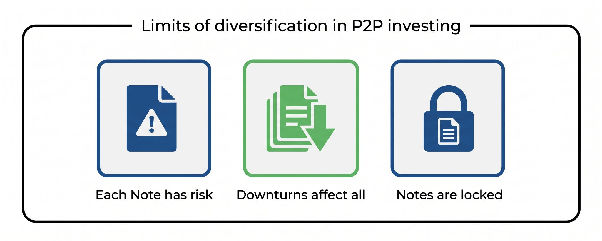
Image: Three limits of diversification in P2P investing on microLEAP.
Diversification can help reduce the impact of an individual default on a portfolio, but it does not eliminate the risk of loss. Investors should understand that spreading investments across multiple Investment Notes, Issuers, sectors and risk grades cannot fully insulate a portfolio from credit risk or broader economic uncertainties.
Several limitations are worth considering:
- Individual credit risk remains. Each Investment Note carries its own repayment risk, regardless of how many other Investment Notes an Investor holds. A diversified portfolio may still incur losses if one or more Issuers fail to meet their repayment obligations.
- Systemic risks can affect multiple Issuers. Economic downturns, rising financing costs or other adverse market conditions may affect multiple Issuers simultaneously, including those operating in different sectors and across different risk grades.
- Limited liquidity. Investment Notes are not liquid investments. Once funds are committed, Investors generally cannot withdraw them before maturity and may need to wait for scheduled repayments to regain access to their capital. Actual repayment timing may also be affected by Issuer delays or defaults.
In addition, the Securities Commission Malaysia (SC) encourages retail Investors to limit their total investment exposure across P2P financing platforms to a maximum of RM50,000 at any one time as a risk-management measure. Retail Investors should also understand the risks associated with investing beyond this threshold.
Ultimately, diversification is a risk-management tool, not a guarantee against losses. Investors should assess their overall exposure, understand the risks associated with each Investment Note and ensure that their investments remain aligned with their financial circumstances and risk tolerance.
For a closer look at how to evaluate platform default rates, see How to Assess Risk & Default Rates When Choosing a P2P Platform in Malaysia.
Frequently asked questions about P2P investment diversification in Malaysia
How many P2P Investment Notes should I hold to achieve diversification?
There is no universal number of Investment Notes that guarantees adequate diversification. The objective is to avoid excessive concentration in any single Investment Note or Issuer. For example, allocating RM5,000 across 10 Investment Notes of RM500 each distributes exposure more evenly than placing the entire amount in a single Note. However, the number of Investment Notes held is only one consideration. Diversifying across risk grades, tenors and business sectors is equally important in managing concentration risk.
Can I diversify across both Shariah-compliant and Conventional Investment Notes on microLEAP?
Yes. microLEAP offers both Shariah-compliant and Conventional Investment Notes, allowing Investors to select opportunities according to their preferences. Investors can use the platform’s available filters to identify Investment Notes that match their criteria. However, holding both types does not automatically reduce credit risk, as diversification also depends on the underlying Issuers, sectors and other risk factors.
Should I diversify across all four dimensions, or is investing in multiple Investment Notes sufficient?
Investing across multiple Investment Notes can help reduce concentration in an individual Note, but it may not address concentration across Issuers, risk grades, sectors or tenors. For example, a portfolio comprising numerous Investment Notes may still be concentrated in High Risk Notes, a single business sector or longer tenors. Diversifying across all four dimensions provides a broader approach to managing different forms of concentration risk.
Can I reinvest my P2P repayments to further diversify my portfolio?
Yes. As Monthly and Balloon repayments are received, the funds are credited to the Investor’s Available Balance and can be reinvested in new Investment Notes, subject to availability. Reinvesting across different Issuers, risk grades, sectors and tenors can help broaden portfolio exposure over time. Auto-Invest can also facilitate this process by allocating available funds to eligible Investment Notes that match the Investor’s predefined criteria, subject to availability and applicable allocation rules.
Should I spread my P2P investments across different risk grades?
Diversifying across risk grades can help Investors distribute their exposure across different levels of assessed credit risk. Concentrating investments in a single grade may leave a portfolio more exposed to similar credit-risk characteristics. However, no risk grade is risk-free. Even Low Risk Investment Notes remain subject to delayed repayments, default and potential loss of capital. Investors should select risk grades that align with their financial objectives and risk tolerance rather than pursuing higher potential returns alone.
What happens to my portfolio if multiple Issuers default at the same time?
Multiple defaults can have a significant impact on a portfolio, particularly if the affected Investment Notes represent a substantial share of the Investor’s total exposure. Each default may result in reduced or lost returns and put the capital invested in the affected Note at risk. Diversification can limit the proportion of a portfolio exposed to any single Issuer, but simultaneous defaults across multiple Issuers may still result in substantial losses.
P2P Investment Notes are not capital-guaranteed and are not protected by the Perbadanan Insurans Deposit Malaysia (PIDM) or the Capital Market Compensation Fund (CMCF). Investors should therefore assess their overall exposure and invest only within their financial means and risk tolerance.
Conclusion
Effective diversification in P2P financing goes beyond holding multiple Investment Notes. It involves spreading investments across four key dimensions: risk grades, tenors, business sectors and Issuers, each addressing a different form of concentration risk.
On microLEAP, the minimum investment of RM10 per Investment Note allows Investors to distribute their capital across multiple Notes with a relatively small initial amount. Auto-Invest further supports the implementation of a diversification strategy by automatically allocating available funds to eligible Investment Notes that match the Investor’s predefined criteria, subject to availability and applicable allocation rules. However, neither approach guarantees allocation or eliminates investment risk.
Ultimately, diversification is a means of managing concentration risk, not a safeguard against losses. P2P Investment Notes are not capital-guaranteed and are not protected by the Perbadanan Insurans Deposit Malaysia (PIDM) or the Capital Market Compensation Fund (CMCF).
All investments carry risk. Investors should carefully assess their financial circumstances and risk tolerance, and refer to microLEAP’s Terms and Conditions for the full terms and applicable risk disclosures before investing.
Regulatory and advertising disclosures
This advertisement has not been reviewed by the Securities Commission Malaysia.
microLEAP PLT is registered with the Securities Commission Malaysia as a Recognised Market Operator to operate a P2P financing platform. Registration with the SC does not constitute a recommendation or endorsement by the SC of microLEAP, its products, services or any Investment Note.
P2P Investment Notes are not capital-guaranteed or protected by PIDM. Investors may experience delayed repayment, Issuer default, and partial or total loss of principal. Returns are not guaranteed.