Key takeaways
- P2P financing is legal in Malaysia and regulated by the Securities Commission Malaysia (SC). Only SC-regulated operators are allowed to run a platform.
- SC regulations require every operator to hold investor funds in an independent trust account, assess every Issuer before listing, and disclose risk openly.
- You can verify any platform yourself on the SC's official register before committing an investment.
- Your capital is not guaranteed, but the risk is managed. microLEAP's default rate is 0.25%, the lowest among SC-regulated P2P platforms.
- If a platform ceases operations, your money stays with an independent trustee, not with the operator.
Introduction
If you have searched whether P2P financing is a scam in Malaysia, you are not alone. It is one of the first questions people ask, and the scepticism is fair. Anytime returns look higher than a bank, it is sensible to ask who is watching.
Legitimate P2P financing in Malaysia is regulated by the Securities Commission (SC) Malaysia, and this article explains exactly how that protects you. The confusion usually comes from unregulated schemes that copy the language of real platforms, which is exactly why knowing the difference matters.
This article covers whether P2P financing is legal, what SC regulation actually requires, how to tell a regulated platform from an unlicensed one, what happens to your money, and what happens if a platform ever shuts down.
Is P2P financing legal in Malaysia?
Yes. P2P financing is legal in Malaysia and regulated by the SC. Only operators that are regulated by SC are permitted to operate P2P financing platforms.
A P2P platform cannot simply launch a website and accept investments from the public. To operate legally, it must be a Recognised Market Operator and comply with the regulatory requirements set by SC. microLEAP operates through Microleap PLT (201804001722 (LLP0016104-LGN)), which is listed on the SC's official register of P2P financing platform operators. As an SC-regulated entity, microLEAP operates under regulatory oversight, with a publicly identified management team and a verifiable registration record. This distinguishes it from unregulated or anonymous schemes that operate without accountability to a recognised regulator.
What does SC regulation actually require?
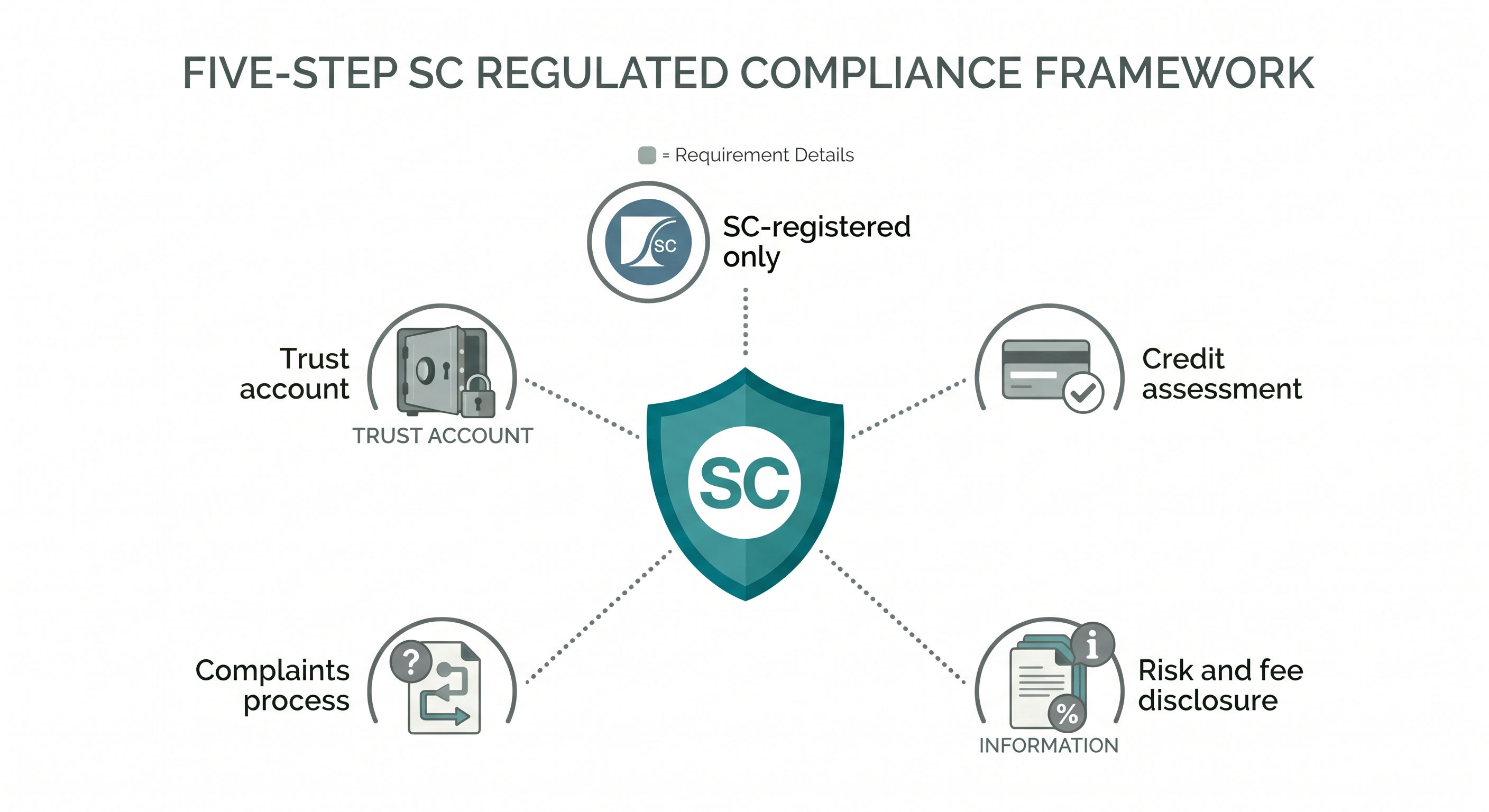
Image: SC regulation requirements for P2P financing platforms in Malaysia.
P2P financing regulation in Malaysia is not a label that a platform can simply assign to itself. Rather, it is a regulatory framework comprising a set of legal obligations that every P2P operator must comply with.
- Investors’ funds are held in an independent trust account, kept separate from the operator's own funds at all times.
- Every Issuer goes through a credit assessment before an Investment Note is published for funding.
- Risk, fees, and default rates are disclosed openly on the platform so investors can see them before committing funds.
- A defined process for handling defaults and complaints must exist and be followed.
- Only operators that are SC regulated are allowed to operate.
See how microLEAP applies these rules in practice, including the credit assessment process and risk disclosure.
Regulated vs unlicensed: How do you tell the difference?
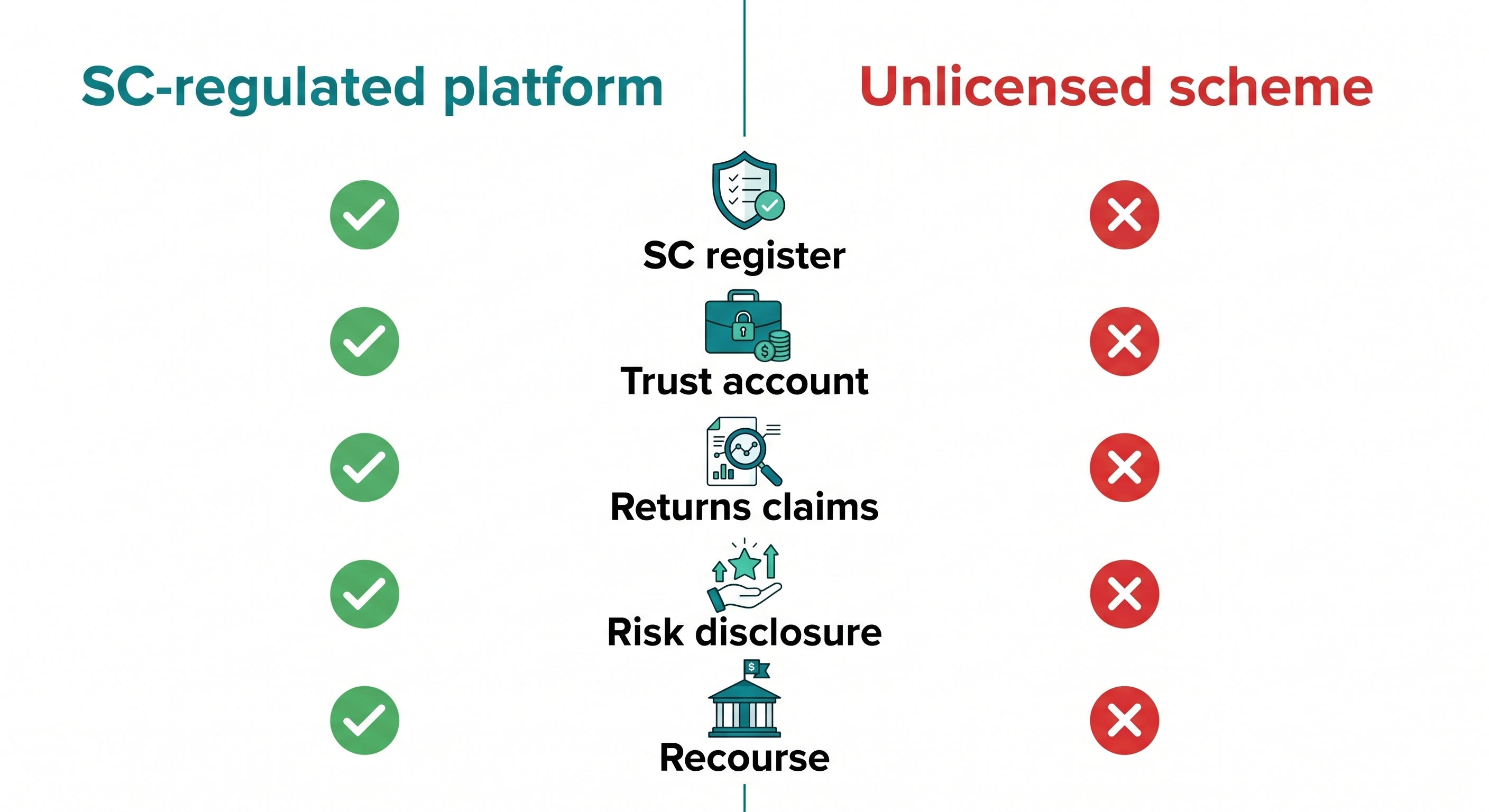
Image: SC-regulated P2P platform versus unlicensed scheme comparison.
P2P financing is not a scam in Malaysia when the platform is SC-regulated. A regulated operator is listed on SC's official register and holds your funds in an independent trust account. An unlicensed scheme has neither and offers little or no recourse if things go wrong.
Part of the scam perception around P2P comes from unregulated schemes being mistaken for regulated platforms.
| What to check | SC-regulated P2P platform | Unlicensed scheme |
|---|---|---|
| On the SC register | Yes | No |
| Where your money is held | Independent trust account | Often the operator's own account |
| Returns claims | Risk-rated and disclosed | Often "guaranteed" or unusually high |
| Risk disclosure | Required and published | Vague or missing |
| Recourse if things go wrong | SC framework and trustee structure | Little or none |
You can check any platform on the SC's official register yourself.
Will you lose your money with P2P financing?
As with any investment, your capital is not guaranteed. However, P2P financing in Malaysia operates within a regulated framework where risks are disclosed and managed, rather than hidden. Ultimately, you decide how much risk you are comfortable taking on.
P2P financing is not a deposit, so there is some element of default risk if a business cannot repay. On a regulated platform, that risk is kept visible and structured:
- P2P financing is not capital-guaranteed. There is some element of default risk. That is the honest starting point.
- microLEAP's default rate is 0.25%, the lowest among SC-regulated P2P platforms in Malaysia. Default rates vary by platform and by the risk level of the Notes. A low rate reflects how strictly Issuers are screened before listing.
- Credit ratings (Low, Medium, or High) on every Note let you choose the risk level you are comfortable with.
- Notes are backed by two guarantors.
- Diversifying your Investment Portfolio across multiple Investment Notes can help mitigate the impact of any single default.
Each Investment Note displays its risk rating on microLEAP, and you can filter by risk level, sector, and tenor to find Notes that suit you.
What happens if a P2P platform shuts down?
Because your money sits in an independent trust account and not with the operator, your funds do not simply disappear if a platform ceases operations.
Under the SC's trust-account structure, investors’ funds are held by an independent trustee rather than the platform itself. For microLEAP, that trustee is Universal Trustee (Maybank Trustees Berhad). If an operator ceases business, ongoing Notes continue to be administered through the trustee, and SC-regulated operators are required to have wind-down arrangements in place. Your funds are held within a regulated structure, not dependent on the platform's continued operation.
Frequently asked questions (FAQ) about P2P financing in Malaysia
Is P2P financing a good investment in Malaysia?
P2P financing can be a good investment in Malaysia for investors who want higher return potential than a fixed deposit and are comfortable with some element of default risk. Returns on microLEAP can reach up to 18% p.a., depending on the Notes chosen. It works best as a complementary layer alongside existing savings, not as a replacement for capital-protected products.
Is P2P financing safer than a unit trust?
P2P financing and unit trusts carry different types of risk, so neither can be considered inherently safer than the other. Unit trusts are subject to market risk, meaning the value of your investment can rise or fall depending on the performance of the underlying assets, and your capital is not guaranteed. P2P financing, on the other hand, primarily carries default risk, which is the risk that a business may be unable to repay its financing obligations.
For a full comparison of returns, protection, and minimum entry, see P2P Financing vs Fixed Deposit vs Unit Trust: Which Gives Better Returns in Malaysia?.
Can I lose money in P2P financing?
Yes. There is an element of default risk. If a business cannot repay, you may not recover the full amount. microLEAP manages this through strict credit assessment, personal or corporate guarantors on every Note, and an active collections process. Diversifying across several Notes reduces the impact of any single default.
Is P2P financing regulated in Malaysia?
Yes. P2P financing in Malaysia is regulated by the Securities Commission (SC) Malaysia. Only SC-regulated operators are permitted to run a platform. microLEAP is listed on the SC's official register as a Recognised Market Operator. You may verify this for yourself on the SC register.
How are P2P financing returns paid?
On microLEAP, Issuers make monthly repayments throughout the Note tenor. These are credited directly to your Available Balance, which you can withdraw or reinvest into new Notes at any time.
What do credit ratings mean in P2P financing?
Credit ratings on microLEAP indicate the risk level of each Investment Note based on the Issuer's credit assessment. Notes are rated Low Risk (LR1-3), Medium Risk (MR4-7), or High Risk (HR8-10). You choose which rating level to invest in based on how much risk you are comfortable taking.
Can beginners invest in P2P financing?
Yes. microLEAP's minimum investment is RM10 per Investment Note, which makes it accessible to first-time investors. Starting with small amounts across several Notes lets you learn how repayments work and build familiarity with the platform before committing larger sums.
Conclusion
P2P financing in Malaysia is regulated by the Securities Commission Malaysia. Investor funds are held in an independent trust account, and investors can verify any licensed platform on the SC register before investing. microLEAP offers both conventional and Shariah-compliant financing options.
It is understandable that some investors may be cautious about P2P financing. However, licensed platforms operate within a regulated and transparent framework and are listed on the SC register.
Ultimately, the best protection is being informed. Before investing, take the time to review the platform on the SC Register, understand how it operates, and ensure you are aware of the risks involved. All investments carry risk, including the possibility of delayed repayments and default. Returns are not guaranteed. Understand how each investment structure works before making any decision.