Key takeaways
- Credit ratings are an assessment, not a guarantee. A credit rating is assigned to a P2P Investment Note before it is listed and reflects the assessed creditworthiness of the Issuer at that point in time. It does not guarantee repayment or eliminate the risk of default.
- microLEAP uses a 10-grade credit rating system. The system comprises three risk bands: Low Risk (LR1 to LR3), Medium Risk (MR4 to MR7) and High Risk (HR8 to HR10). Each grade reflects an assessment of the Issuer's cash flow strength and Debt Service Ratio (DSR).
- P2P investments are not deposit-protected. Investment Notes are not protected by Perbadanan Insurans Deposit Malaysia (PIDM) or covered by the Capital Market Compensation Fund (CMCF), irrespective of their assigned credit ratings.
- Liquidity is limited. Funds invested in a P2P Investment Note are generally committed for the duration of its tenor and cannot be withdrawn on demand. Investors should consider their liquidity needs before investing.
- Credit ratings are only one part of the investment decision. Investors should also evaluate the profit rate, investment tenor and repayment structure. While a lower-risk grade indicates a comparatively lower assessed level of credit risk, it does not mean the investment is risk-free. All Investment Notes carry some degree of default risk, and Investors may lose part or all of their principal.
Introduction
When reviewing an Investment Note on microLEAP, Investors may come across a credit rating such as LR3 or HR8 and wonder what it signifies and how it should factor into their investment decision. The rating provides an indication of the assessed creditworthiness of the Issuer and is one of the key considerations when evaluating an Investment Note before investing.
microLEAP PLT is registered with the Securities Commission Malaysia (SC) as a Recognised Market Operator (RMO) to operate a peer-to-peer (P2P) financing platform. On the platform, the business seeking financing is referred to as the Issuer, while individuals or entities providing financing are referred to as Investors.
This article examines how microLEAP's credit rating system works, the factors considered in assigning ratings, what the different grades indicate, and how Investors can use this information when assessing Investment Notes. It also outlines the limitations of credit ratings and the risks Investors should consider before committing funds.
What is a credit rating on a P2P Investment Note in Malaysia?
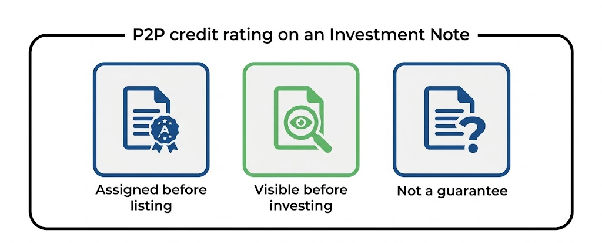
Image: What a P2P credit rating on an Investment Note means on microLEAP.
A credit rating on a peer-to-peer (P2P) Investment Note is a grade assigned by the platform to indicate its assessment of the Issuer’s creditworthiness and the associated risk of default. It provides Investors with a reference point for evaluating the relative credit risk of an Investment Note before committing funds.
On microLEAP, every Investment Note is assigned a credit rating before it is listed on the platform. Investors can review the rating alongside other relevant investment information when assessing whether a Note aligns with their risk appetite and investment objectives.
The rating reflects the Issuer’s assessed creditworthiness at the time of listing. As the financial position and repayment capacity of an Issuer may change over time, the rating should not be interpreted as a guarantee of repayment or a definitive prediction of the Note’s performance.
Ultimately, a credit rating is a tool to support informed investment decisions, not an assurance of a particular outcome. Investors should consider it alongside other factors, including the profit rate, investment tenor, repayment structure and their capacity to bear potential losses.
How does microLEAP assign credit ratings to P2P Investment Notes?
Before an Investment Note is listed, microLEAP conducts a credit assessment to evaluate the Issuer’s creditworthiness and assign an appropriate risk grade.
The assessment considers key indicators of repayment capacity, including operational cash flow, existing debt obligations, verified bank statements and credit bureau records. For micro-enterprises with limited formal financial documentation, alternative credit assessment tools may also be used to develop a more comprehensive view of the business’s financial position and ability to meet its obligations.
The resulting credit assessment informs the risk grade and profit rate assigned to the Investment Note, reflecting the relationship between potential Investor returns and the assessed level of credit risk. However, a credit rating represents an assessment based on information available at the time of listing and may not reflect subsequent changes in the Issuer’s financial circumstances.
Investors should therefore consider the credit rating alongside the stated profit rate, tenor, repayment structure and available Issuer information when evaluating an Investment Note. A credit rating is a tool for assessing risk, not a guarantee of repayment or future investment performance.
What do the P2P credit rating grades mean on microLEAP?
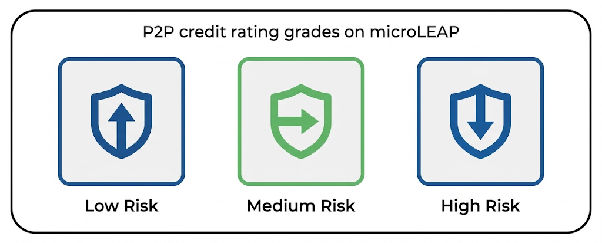
Image: The three P2P credit rating bands on microLEAP: Low Risk, Medium Risk and High Risk.
microLEAP uses a 10-grade credit rating system, grouped into three risk bands: Low Risk (LR1 to LR3), Medium Risk (MR4 to MR7) and High Risk (HR8 to HR10). Each grade reflects an assessment of the Issuer’s creditworthiness, taking into account key indicators such as cash flow strength and Debt Service Ratio (DSR).
The grades provide Investors with a framework for comparing the relative credit risk of different Investment Notes. Generally, a lower-risk grade indicates stronger assessed credit quality and a lower risk of default, while a higher-risk grade indicates greater credit risk. The assigned grade also informs the profit rate applicable to the Investment Note.
However, these ratings are assessments rather than guarantees. Even Investment Notes in the Low Risk category may experience delayed repayments, default or loss of capital.
Low Risk: LR1, LR2, and LR3
The Low Risk band comprises three grades associated with comparatively stronger assessed credit quality and a lower risk of default relative to the Medium and High Risk bands.
- LR1 - Lowest assessed risk: Represents the strongest credit quality within microLEAP’s rating framework, characterised by very strong cash flow and a very low DSR. Investment Notes in this category carry the lowest assessed risk of default within the 10-grade system and are associated with the lowest profit rates under the platform’s rating framework.
- LR2 - Lower assessed risk: Indicates strong credit quality, supported by high cash flow and a low DSR. The associated risk of default and profit rate are generally higher than those of LR1, reflecting the relative differences in assessed credit risk.
- LR3 - Low assessed risk: Reflects good credit quality, supported by good cash flow and a favourable DSR. Although the assessed risk remains within the Low Risk band, it is higher than that associated with LR1 and LR2.
Investors should note that a Low Risk rating does not mean an Investment Note is risk-free. Repayment delays, default and partial or total loss of capital remain possible if the Issuer is unable to meet its obligations.
Medium Risk: MR4, MR5, MR6, and MR7
The Medium Risk band covers four grades representing varying levels of assessed credit quality. These grades generally reflect a less favourable combination of cash flow strength and DSR than those in the Low Risk band, with the associated risk of default increasing across the grades.
- MR4 - Medium-low assessed risk: Reflects medium-strong credit quality, supported by average-to-good cash flow and a favourable-to-average DSR profile. It represents the lower-risk end of the Medium Risk band.
- MR5 - Medium assessed risk: Indicates average credit quality, with average cash flow and DSR characteristics. The Issuer’s repayment capacity warrants closer consideration than that of Issuers in the Low Risk band.
- MR6 - Medium-high assessed risk: Reflects medium-weak credit quality, characterised by below-average cash flow and an above-average DSR. These indicators suggest greater pressure on the Issuer’s capacity to service its financial obligations.
- MR7 - Upper-medium assessed risk: Represents lower-medium credit quality, associated with average-to-low cash flow and an average-to-high DSR. Within the Medium Risk band, this grade indicates comparatively greater assessed credit risk.
Investors should note that the Medium Risk band encompasses a range of credit profiles. Investors should consider the specific grade alongside the Issuer’s financial information, the Investment Note’s repayment structure and their own capacity to absorb potential losses.
High Risk: HR8, HR9, and HR10
The High Risk band comprises three grades associated with weaker assessed credit quality and a higher risk of default relative to the Low and Medium Risk bands. These grades generally reflect weaker cash flow and higher DSR levels.
- HR8 - High assessed risk: Indicates weak credit quality, characterised by low cash flow and a high DSR. These factors suggest greater constraints on the Issuer’s capacity to meet its repayment obligations.
- HR9 - Higher assessed risk: Reflects weaker credit quality, with lower cash flow and a higher DSR than the profile associated with HR8. The assessment indicates a greater degree of credit risk.
- HR10 - Highest assessed risk: Represents the weakest credit quality within microLEAP’s 10-grade system, characterised by very low cash flow and a very high DSR. It carries the highest assessed risk of default within the rating framework and is associated with the highest profit rates under the platform’s rating structure.
Investors should note that a higher profit rate may reflect greater assessed credit risk; it should not be interpreted as compensation that guarantees an adequate return or offsets the possibility of loss. Investors should carefully evaluate the Issuer’s repayment capacity and consider whether the level of risk is consistent with their investment objectives.
How to use P2P credit ratings when selecting an Investment Note
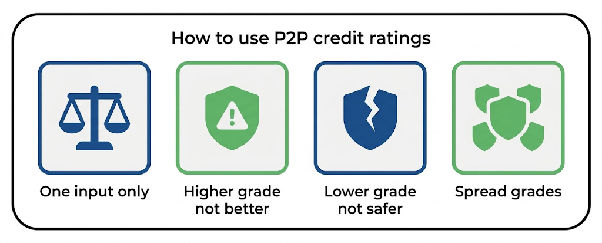
Image: How to use P2P credit ratings on microLEAP.
A credit rating is an important consideration when evaluating a P2P Investment Note, but it should not be viewed in isolation. Investors should assess the rating alongside the stated profit rate, tenor, repayment structure and available information on the Issuer before committing funds.
A higher potential return generally comes with higher credit risk. High Risk Notes may offer higher stated profit rates to compensate for the greater risk of default, but this does not necessarily translate into better investment outcomes. If an Issuer defaults, Investors may receive reduced or no expected returns and may lose some or all of their invested capital.
Conversely, a lower-risk grade does not guarantee repayment or eliminate the possibility of loss. All Investment Notes carry credit risk, regardless of their assigned grade, and Investors should avoid treating ratings as definitive predictions of investment performance.
It is also important to understand the protections that do not apply. P2P Investment Notes are not protected by Perbadanan Insurans Deposit Malaysia (PIDM), the Capital Market Compensation Fund (CMCF) or any deposit insurance scheme, irrespective of the credit rating assigned to a Note.
Diversification across different risk grades can help manage concentration risk, but it does not eliminate the possibility of losses. Investors should also consider diversification across Issuers and business sectors, while ensuring that each investment remains consistent with their financial circumstances and risk tolerance.
Before investing, review the credit rating, stated profit rate, tenor, repayment structure and available Issuer information together. The rating provides an indication of the Issuer’s credit profile; it should inform an investment decision, not be treated as a guarantee of repayment or a prediction of the eventual outcome.
The Securities Commission Malaysia (SC) encourages retail Investors to limit their total investment exposure across P2P financing platforms to a maximum of RM50,000 at any one time as a risk-management measure. This is an advisory threshold, not a guarantee of investment safety. Retail Investors should assess their aggregate exposure across platforms and understand the additional risks associated with exceeding the recommended threshold.
For a practical guide to evaluating the factors that influence P2P investment returns, see What Affects Your P2P Investment Returns? Tenor, Risk Grade & Repayment.
For guidance on managing concentration risk through diversification across risk grades, see How to Diversify Your P2P Investments to Manage Risk.
Frequently asked questions about P2P credit ratings in Malaysia
What does LR3 mean on a P2P Investment Note in Malaysia?
LR3 is a Low Risk grade within microLEAP’s 10-grade credit rating system. It reflects the Issuer’s assessed credit profile, with indicators such as cash flow and Debt Service Ratio (DSR) contributing to the evaluation. LR3 Investment Notes are associated with a lower stated potential return and a lower assessed risk of default than Medium and High Risk grades.
However, Low Risk does not mean risk-free. Investors may still face delayed repayments, Issuer default or the loss of some or all of their invested capital.
How does DSR affect a P2P credit rating in Malaysia?
Debt Service Ratio (DSR) measures the proportion of an Issuer’s income committed to servicing debt obligations. It is one of the two primary indicators in microLEAP’s credit scoring engine, alongside cash flow.
A lower DSR generally indicates that a smaller proportion of income is committed to debt servicing, potentially leaving greater capacity to meet repayment obligations. Conversely, a higher DSR indicates that more income is allocated to existing debt, which may increase the assessed credit risk. DSR is considered alongside cash flow and other relevant information when evaluating an Issuer’s credit profile.
Is a Low Risk P2P Investment Note safe to invest in?
No credit grade guarantees the safety of an investment. A Low Risk grade reflects the assessed level of credit risk at the time the Investment Note is listed; it does not eliminate the possibility of default or loss.
Even with a Low Risk Investment Note, the Issuer may fail to meet its repayment obligations, resulting in delayed payments or the loss of part or all of the capital invested. P2P Investment Notes are not capital-guaranteed and are not protected by Perbadanan Insurans Deposit Malaysia (PIDM) or the Capital Market Compensation Fund (CMCF), regardless of the assigned risk grade.
Investors should assess their financial circumstances and risk tolerance before committing funds.
Should I avoid High Risk P2P Investment Notes entirely?
Not necessarily. High Risk Investment Notes may offer higher stated potential returns to compensate for their higher assessed credit risk, including a greater risk of default. However, a higher potential return does not necessarily translate into a better investment outcome.
Whether a High Risk Investment Note is appropriate depends on an Investor’s financial circumstances, investment objectives and risk tolerance. Before investing, consider the credit rating alongside the stated profit rate, tenor, repayment structure and available Issuer information. Investors should not commit funds solely on the basis of the potential return.
Can a P2P credit rating change after I have invested in a Note?
On microLEAP, the credit rating assigned to an Investment Note reflects the Issuer’s assessed credit profile based on information available at the time of listing. The assigned grade does not automatically update to reflect subsequent changes in the Issuer’s financial position or repayment capacity during the financing period.
As a result, the original rating may not fully reflect the Issuer’s circumstances throughout the life of the investment. Investors should understand that an assessment made at the time of listing cannot guarantee future repayment performance.
Does microLEAP’s credit rating guarantee that an Issuer will repay?
No. A credit rating is an assessment of an Issuer’s creditworthiness at the time an Investment Note is listed, not a guarantee of repayment. All grades within microLEAP’s LR1-to-HR10 rating system carry some degree of default risk.
If an Issuer fails to meet its repayment obligations, Investors may experience delayed repayments or lose part or all of the capital invested. Credit ratings should therefore be used as one input in the investment decision, alongside the stated profit rate, tenor, repayment structure and available Issuer information. Investors should not rely on a credit rating alone when assessing the risks of a P2P Investment Note.
Conclusion
A credit rating provides an assessment of an Issuer’s creditworthiness at the time an Investment Note is listed, based on factors including cash flow and Debt Service Ratio (DSR). It is not a guarantee of repayment. All 10 grades, from LR1 to HR10, carry some degree of default risk across the Low Risk, Medium Risk and High Risk categories.
Investors should use the credit rating as one component of their investment assessment, alongside the stated profit rate, tenor, repayment structure and available Issuer information. These details are provided on each Investment Note before an investment is made and should be considered together to support a more informed decision.
All investments carry risk, including the potential loss of capital. Investors should carefully assess their financial circumstances and risk tolerance, and refer to microLEAP’s Terms and Conditions for the full terms and applicable risk disclosures before investing.
Regulatory and advertising disclosures
This advertisement has not been reviewed by the Securities Commission Malaysia.
microLEAP PLT is registered with the Securities Commission Malaysia as a Recognised Market Operator to operate a P2P financing platform. Registration with the SC does not constitute a recommendation or endorsement by the SC of microLEAP, its products, services or any Investment Note.
P2P Investment Notes are not capital-guaranteed or protected by PIDM. Investors may experience delayed repayment, Issuer default, and partial or total loss of principal. Returns are not guaranteed.