Key takeaways
- Different financing structures, different requirements. Peer-to-peer (P2P) financing and bank loans differ in their eligibility criteria, assessment processes, costs and funding timelines. MSMEs should evaluate both options against their financing needs, financial position and repayment capacity before applying.
- A rejected bank loan application does not automatically rule out P2P financing. P2P financing platforms may apply different assessment criteria and evaluate applications based on their respective risk assessment frameworks. However, eligibility and approval remain subject to each platform’s requirements and assessment.
- Financing approval is not guaranteed. All financing applications submitted through microLEAP are subject to eligibility checks, credit assessment and approval. Approval, financing amounts, rates, tenors, successful funding and disbursement are not guaranteed.
- Understand the regulatory framework. microLEAP PLT is registered with the Securities Commission Malaysia (SC) as a Recognised Market Operator (RMO). Such registration should not be construed as a recommendation or endorsement by the SC of microLEAP, its financing products or any individual financing application.
- Review the contractual terms before proceeding. Before raising financing through microLEAP, businesses should carefully review and understand the Issuer Agreement, the separate Funding Contract and applicable Key Contract Terms, as well as any relevant guarantee, indemnity or Islamic financing documents. These documents set out the respective rights, obligations and responsibilities of the business, microLEAP and, where applicable, Investors, and should be understood in full before the business becomes legally bound.
Introduction
For Malaysian micro, small and medium enterprises (MSMEs), choosing the right financing option involves more than comparing costs. Understanding the differences between peer-to-peer (P2P) financing and bank loans, including their application processes, eligibility requirements and funding timelines, can help businesses make more informed financing decisions.
microLEAP PLT is registered with the Securities Commission Malaysia (SC) as a Recognised Market Operator (RMO) to operate a P2P financing platform. On the microLEAP platform, a business seeking to raise financing is referred to as an Issuer, while Investors provide funds through the platform, subject to the applicable arrangements and terms.
This article examines how P2P financing compares with bank loans across key considerations, including application procedures, eligibility criteria, financing costs and available options for Malaysian MSMEs.
For a broader overview of P2P financing products available to Malaysian MSMEs, see P2P Financing for Small Businesses in Malaysia.
Why do Malaysian MSMEs consider P2P financing over bank loans?
Malaysian micro, small and medium enterprises (MSMEs) may consider peer-to-peer (P2P) financing as an alternative to bank loans based on their business needs, financing requirements and financial circumstances. Factors such as operating history, documentation requirements and funding timelines may influence which option a business chooses to explore.
Traditional bank financing may require businesses to meet specific credit criteria, provide supporting documentation and, depending on the facility, offer collateral. For newer businesses or those with limited operating histories, meeting these requirements may present challenges.
An unsuccessful bank financing application does not automatically mean that a business is ineligible for P2P financing. P2P financing platforms may apply different assessment criteria, although each application remains subject to the platform's eligibility requirements, credit assessment and approval process.
On microLEAP, P2P financing is facilitated through an online platform that connects businesses seeking financing with Investors. The application process is conducted digitally, while successful funding and subsequent disbursement remain subject to the applicable assessment, approval and funding requirements.
Ultimately, P2P financing and bank loans have different structures, costs, requirements and risk considerations. MSMEs should compare the available options against their financing needs, repayment capacity and overall financial position before deciding which route to pursue.
How does applying for P2P financing compare with a bank loan in Malaysia?
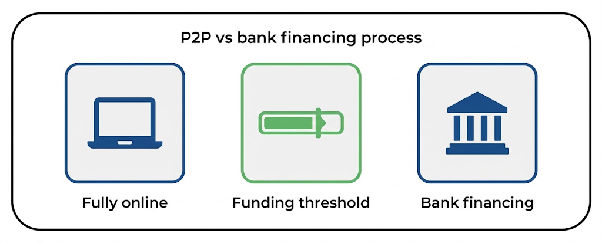
Image: How the P2P financing application process compares to bank financing in Malaysia.
The application process for peer-to-peer (P2P) financing on microLEAP is conducted entirely online. However, the time required to obtain financing depends on several factors, including the completeness of the application, the outcome of the credit assessment and whether the financing request meets the applicable funding threshold within the designated funding period.
For microLEAP's Micro Financing product, a credit decision is typically made within three to five working days, subject to complete documentation and the outcome of the credit assessment. Other financing products may have different assessment timelines.
Following approval, the financing request is listed on the platform for Investors to consider and fund. Disbursement may proceed once at least 80% of the funding target is achieved within the stipulated funding period, subject to the fulfilment of applicable pre-disbursement conditions and documentation requirements. Where funding falls short of the target, adjusted financing terms may apply.
Bank loan applications typically involve document submission, credit assessments and verification procedures, although some banks offer digital application channels and financing facilities that do not require property collateral. Documentation, security and operating-history requirements vary depending on the bank, financing product and applicant’s profile. Some applications may also require a branch visit or further verification, with processing times varying across financial institutions and facilities.
While microLEAP offers a fully digital application process, this does not necessarily mean that every P2P financing application will be completed faster than a bank loan application. The overall timeline from application to disbursement depends on the financing product, documentation requirements, credit assessment and funding outcome.
MSMEs should therefore consider both the application process and the time needed to secure funding when evaluating their financing options.
How does P2P financing eligibility differ from bank loan eligibility in Malaysia?
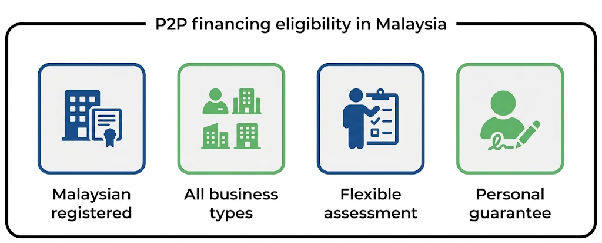
Image: P2P financing eligibility requirements for Malaysian MSMEs on microLEAP.
Eligibility requirements for peer-to-peer (P2P) financing and bank loans differ, with each provider applying its own assessment criteria. On microLEAP, eligible Malaysian-registered businesses with at least six months of operating history may apply for financing, subject to the relevant product requirements, credit assessment and approval.
For some businesses, particularly those with a shorter operating history or limited financial documentation, P2P financing may provide an additional avenue to explore. However, eligibility does not guarantee approval or successful funding.
Subject to the applicable financing product and eligibility criteria, businesses generally need to meet the following requirements:
- Business registration: The business must be registered in Malaysia.
- Operating history: At least six months of business operations.
- Banking facilities: An active business bank account.
- Financial records: Basic financial information and supporting documents relevant to the application.
Eligible business structures may include sole proprietorships, partnerships, limited liability partnerships (LLPs), private limited companies (Sdn Bhd), unlisted public companies and subsidiaries of public-listed companies, subject to the applicable product requirements.
How much does P2P financing cost compared with a bank loan in Malaysia?
The cost of peer-to-peer (P2P) financing and bank loans depends on the financing amount, tenor, applicable rates and associated fees. For Malaysian micro, small and medium enterprises (MSMEs), comparing the total cost of financing, rather than the quoted rate alone, is important when evaluating available options.
Financing through microLEAP involves the following fees and charges:
- Application fee: RM50 at the application stage, subject to the current fee schedule and applicable terms.
- Platform fee: A one-time fee of 2% to 8% of the financing principal, depending on the financing tenor, is deducted from the financing proceeds before disbursement. The applicable fee, including any taxes and other charges, should be confirmed for the specific financing offer.
- Profit rate: The applicable rate is assigned based on the Issuer's credit risk score and other relevant factors. The rate is disclosed before the Issuer accepts the financing offer.
The applicable profit rate, fees and deductions are set out in the offer documents before the Issuer accepts the financing offer. Businesses should review these terms carefully to understand the total cost of financing and the net amount they will receive.
Bank financing costs vary depending on the financial institution and the type of facility. These may include interest charges, processing fees and other applicable costs. Interest rates and fee structures differ across banks and products, so businesses should review the relevant offer terms before making a decision.
When comparing P2P financing with a bank loan, businesses should consider:
- Total financing cost: Include interest or profit charges, application fees, platform fees and other applicable charges.
- Net disbursement amount: Account for fees deducted upfront and determine how much financing will actually be received.
- Repayment obligations: Review the repayment schedule, tenor and the effect of repayments on business cash flow.
- Overall financing terms: Consider the total cost alongside eligibility requirements, funding timelines and the intended use of the funds.
Neither financing option is necessarily less expensive in every situation. The actual cost depends on the terms offered to the business. MSMEs should compare the full cost of funds and assess their repayment capacity before committing to either option.
What P2P financing options are available to Malaysian MSMEs through microLEAP?
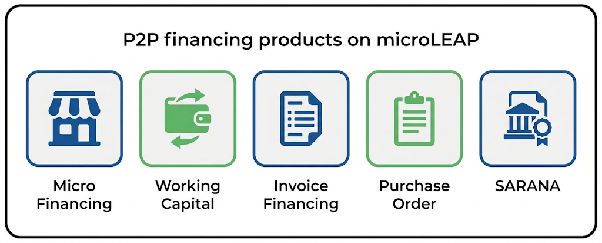
Image: P2P financing products available to Malaysian MSMEs on microLEAP.
microLEAP offers six financing options to meet the diverse funding needs of Malaysian micro, small and medium enterprises (MSMEs), including the SARANA financing route for eligible businesses. Selected products offer financing of up to RM1.5 million, with both Conventional and Shariah-compliant structures available, subject to the relevant product terms. A Financial Support Letter is a separate tender-support document and does not itself constitute financing or result in disbursement.
- Micro Financing: RM1,000-RM50,000, with a tenor of 6-36 months. Eligible Issuers receive complimentary Personal Accident insurance coverage of up to RM50,000, subject to applicable terms.
- Working Capital Financing: Up to RM500,000, with a tenor of 6-36 months, to support day-to-day business operations.
- Invoice Financing: Up to RM1.5 million, with a tenor of up to 180 days and financing of up to 80% of eligible invoice value.
- Purchase Order (PO) Financing: Up to RM1.5 million, with a tenor of up to 180 days and financing of up to 80% of eligible PO value.
- SARANA Financing: Up to RM1.5 million, with a tenor of 3-12 months, for eligible businesses undertaking government contracts. Options include contract implementation (pre-financing) and invoice (post-financing).
- Financial Support Letter (FSL): A document issued to support eligible tender submissions, outlining the nature, amount and conditions of microLEAP’s proposed financial support. The FSL does not constitute a disbursed financing facility, and any subsequent financing remains subject to the applicable terms and conditions.
The appropriate option depends on the business's financing needs, operating history and underlying transaction. All applications are subject to eligibility criteria, credit assessment and approval. Financing limits are not guaranteed.
How should Malaysian MSMEs choose between P2P financing and a bank loan?
Choosing between peer-to-peer (P2P) financing and a bank loan requires businesses to consider more than the financing amount available. Five key factors can help Malaysian micro, small and medium enterprises (MSMEs) evaluate their options: funding requirements, eligibility, total financing cost, repayment structure and funding timeline.
- Financing amount: Determine how much funding the business requires and whether it falls within the limits of the relevant P2P financing product or bank facility.
- Eligibility: Review the eligibility criteria for each option. An unsuccessful bank loan application does not guarantee approval for P2P financing, as each application is subject to an independent assessment.
- Total financing cost: Compare the applicable interest or profit rates, platform fees, processing charges and other costs to understand the overall cost of borrowing.
- Repayment structure: Review the applicable repayment schedule, as terms may vary by product. Repayments may be monthly, involve periodic interest or profit payments with the principal due at maturity, or include a larger final payment. Businesses should assess their cash flow and ensure sufficient funds are available to meet the final principal repayment.
- Funding timeline: Assess how quickly the funds are needed and whether the expected assessment, funding and disbursement timelines are compatible with the business's operational requirements.
Both P2P financing and bank loans provide potential funding avenues for eligible Malaysian MSMEs, but their suitability depends on the business's financial position, funding needs and ability to meet its repayment obligations. Comparing the full terms of each option can help businesses make a more informed financing decision.
For more information on the regulatory framework governing P2P financing in Malaysia, see SC-Regulated P2P Financing for MSMEs: What "Regulated" Really Means.
Frequently asked questions about P2P financing vs bank loans for Malaysian MSMEs
Does a bank loan rejection affect P2P financing eligibility in Malaysia?
Not necessarily. An unsuccessful bank financing application does not automatically disqualify a business from P2P financing, as platforms may apply different assessment criteria. All applications remain subject to the relevant eligibility requirements, credit assessment and approval.
Is P2P financing faster than a bank loan in Malaysia?
The timeline varies by product and provider. On microLEAP, a credit decision for Micro Financing is typically made within 3-5 working days, subject to complete documentation and the credit assessment outcome. Overall funding and disbursement timelines depend on the assessment process and whether the applicable funding threshold is achieved. These timelines are not guaranteed.
Does P2P financing in Malaysia require collateral?
Property collateral is not mandatory for microLEAP's P2P financing. However, directors and/or shareholders may be required to provide a personal guarantee and indemnity, depending on the applicable financing requirements.
Can a business use P2P financing alongside existing bank financing?
A business with existing bank financing may apply for P2P financing, subject to eligibility and credit assessment. A Debt Service Ratio (DSR) assessment is required to evaluate its ability to meet existing and proposed repayment obligations. Businesses should also review their existing bank facility for restrictions on additional borrowing, granting security or assigning receivables, and obtain the bank’s consent where required. Approval is not guaranteed.
Is P2P financing regulated in Malaysia?
Yes. microLEAP PLT is registered with the Securities Commission Malaysia (SC) as a Recognised Market Operator (RMO). Businesses can verify its registration through the SC's official register of Recognised Market Operators. Registration does not constitute an endorsement of the platform or guarantee the approval or outcome of any financing application.
Conclusion
P2P financing and bank loans offer different funding structures, with distinct application processes, eligibility requirements, costs and timelines. The appropriate option depends on an MSME’s financing needs, financial position and repayment capacity.
Through its online platform, microLEAP connects eligible businesses with Investors seeking to provide financing. An unsuccessful bank financing application does not automatically disqualify a business from P2P financing, as each application is assessed independently.
microLEAP offers six financing options for eligible Malaysian MSMEs, ranging from Micro Financing to SARANA, with Shariah-compliant and Conventional financing structures available.
Before applying, businesses should review the relevant eligibility criteria, financing costs, repayment terms and any personal guarantee or indemnity requirements. They should also read the Issuer Agreement carefully to understand their contractual rights and obligations.
All applications are subject to eligibility requirements, credit assessment and approval. Financing approval, amount, rate, tenor, successful funding and disbursement are not guaranteed. Businesses should refer to microLEAP’s applicable Terms and Conditions for further details.
Regulatory and advertising disclosures
This advertisement has not been reviewed by the Securities Commission Malaysia.
microLEAP PLT is registered with the Securities Commission Malaysia as a Recognised Market Operator to operate a P2P financing platform. Registration with the SC does not constitute a recommendation or endorsement by the SC of microLEAP, any financing product or any application.
Financing is subject to eligibility, identity and business verification, credit and compliance assessment, approval, achievement of the applicable funding threshold and completion of the required documentation. Approval, financing amount, rate, tenor, successful funding and disbursement are not guaranteed.
Applicable financing/profit rates, fees, taxes, charges and deductions will be disclosed in the relevant offer and final documents. Calculator results are estimates only and do not constitute an offer, approval or final financing terms.