
Key takeaways
- A fixed deposit is predictable and PIDM-insured up to RM250,000, but rates of around 2 to 4 percent a year rarely keep pace with inflation.
- Unit trust returns vary by fund and are not guaranteed. Management fees reduce what you actually keep.
- P2P financing on microLEAP offers returns up to 18% p.a., with monthly repayments credited to your Available Balance and a minimum investment of RM10.
- P2P is not PIDM-insured, but the risk is structured through credit ratings, personal guarantors, and segregated trust accounts on an SC-regulated platform.
- The strongest approach is to layer all three: FD for security, unit trust for managed exposure, and P2P for higher-return potential alongside what you already have.
Introduction
Most Malaysians park their savings in a fixed deposit (FD) or a unit trust. This guide compares both with P2P financing, so you can see which fits your goals.
There is nothing wrong with starting at the fixed deposit. It is secure, the return is predictable, and you always know what you will get back at the end of the tenor. For years it has been the default home for spare cash, and that comfort is well earned.
The gap is growth. FD rates have stayed low, and after inflation your money barely moves. That is the gap more Malaysians are now looking to close, and you no longer need a large sum to explore an alternative. Through microLEAP, you can start P2P financing from as little as RM10. This article covers the returns you can realistically expect, the RM10 entry point that makes P2P accessible, how the risk is structured, and how P2P can sit alongside what you already have.
P2P Financing vs Fixed Deposit vs Unit Trust: Key differences
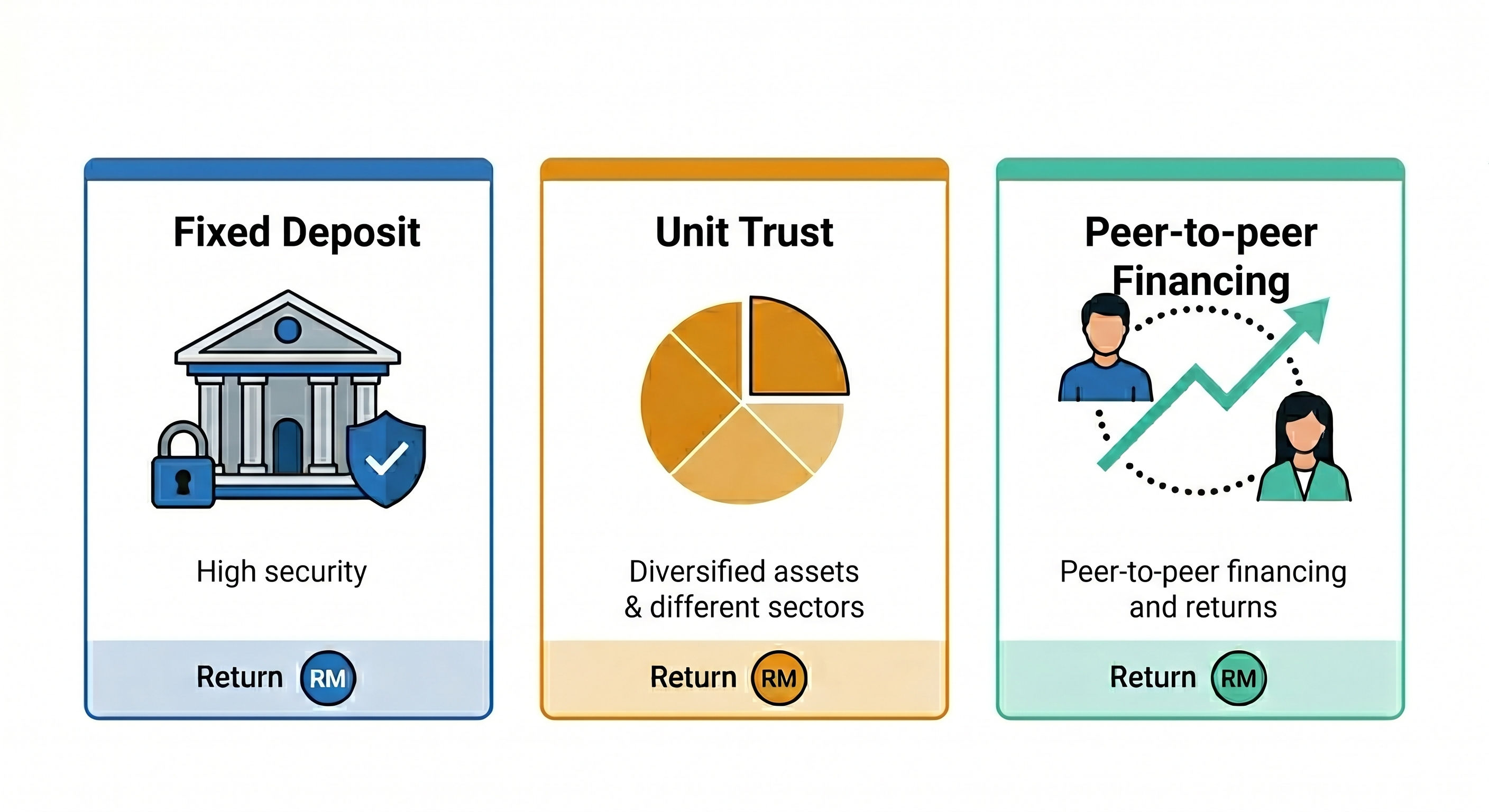
Image: Three investment options: Fixed Deposit, Unit Trust, and P2P Financing.
P2P financing offers the highest return potential of the three, the fixed deposit offers the most certainty, and the unit trust sits between them.
| Investment type | Returns p.a. | Minimum entry | Capital protection | Liquidity | Effort |
|---|---|---|---|---|---|
| Fixed Deposit | ~2–4% | From RM500 | PIDM-insured up to RM250,000 | Locked until maturity | Very low |
| Unit Trust | Varies by fund | Often RM100–RM1,000 | Not capital-guaranteed; value moves with the fund | Usually sellable, takes days | Low to medium |
| P2P Financing (microLEAP) | Up to 18% | From RM10 | Not PIDM-insured; risk-rated + guarantors + trust account | Held until the Note matures | Low to medium |
Disclaimer: Fixed deposit and unit trust figures reflect the general Malaysian market and vary by provider. microLEAP figures sourced from microleapasia.com.
What returns can you expect from each option?
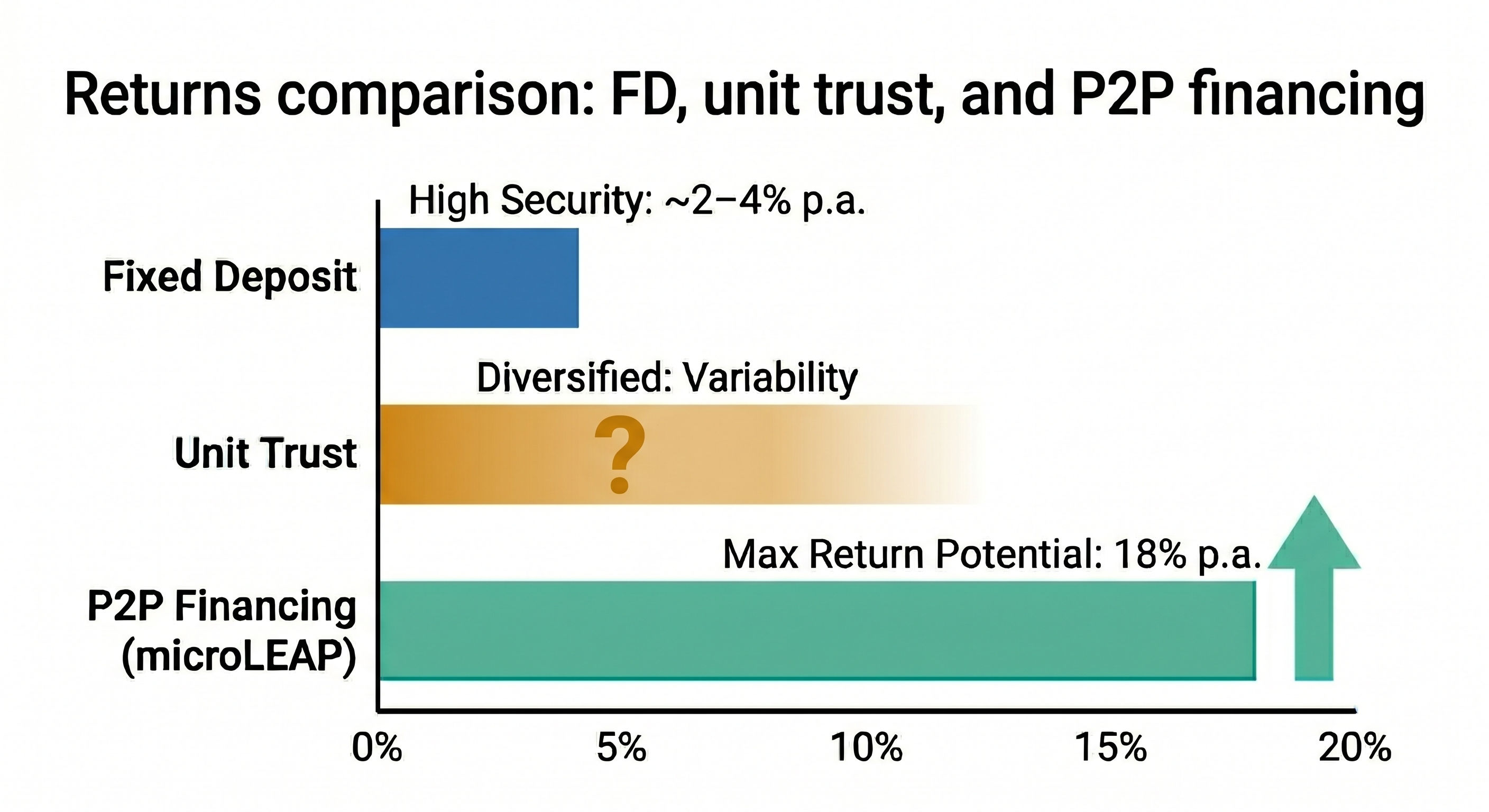
Image: Bar chart comparing annual returns for fixed deposit, unit trust, and P2P financing.
Returns rise as you move from a fixed deposit to a unit trust to P2P financing, and so does the variability. For Malaysians looking for high return investments, understanding what each option actually delivers is the starting point.
Fixed deposit
A fixed deposit locks a lump sum with a bank for a set tenor, usually one, three, six, or twelve months, in exchange for a fixed interest rate. You know the exact return before you start. In Malaysia, rates currently sit at roughly 2 to 4 percent a year, and your deposit is protected by PIDM up to RM250,000. The trade-off is that your money is tied up until maturity, and the rate rarely keeps pace with inflation.
Unit trust
A unit trust in Malaysia pools your money with other investors, and a fund manager allocates it across a range of assets. Returns vary by fund and are never guaranteed. Management and sales fees also reduce what you finally keep, so the headline figure and your net return are not the same number. Unit trusts offer more growth potential than an FD, but come with more variability and no capital guarantee.
P2P financing with microLEAP
With P2P financing, you fund Malaysian businesses through Investment Notes and earn returns as they repay. Both conventional and Shariah-compliant Notes are available on microLEAP. microLEAP offers returns up to 18% p.a., depending on the risk rating of the Note chosen. Repayments arrive monthly and are credited to your Available Balance, which you can withdraw or reinvest. Your actual return depends on the Notes you invest in, and there is some element of default risk.
That risk is actively managed. microLEAP's default rate currently sits at 0.25%, the lowest among SC-regulated P2P platforms in Malaysia, maintained through a stringent credit assessment process, personal guarantors, and an active collections workflow. The higher return is the reward for taking on credit risk. The next section explains exactly how that risk is managed.
Is P2P financing protected like a fixed deposit?
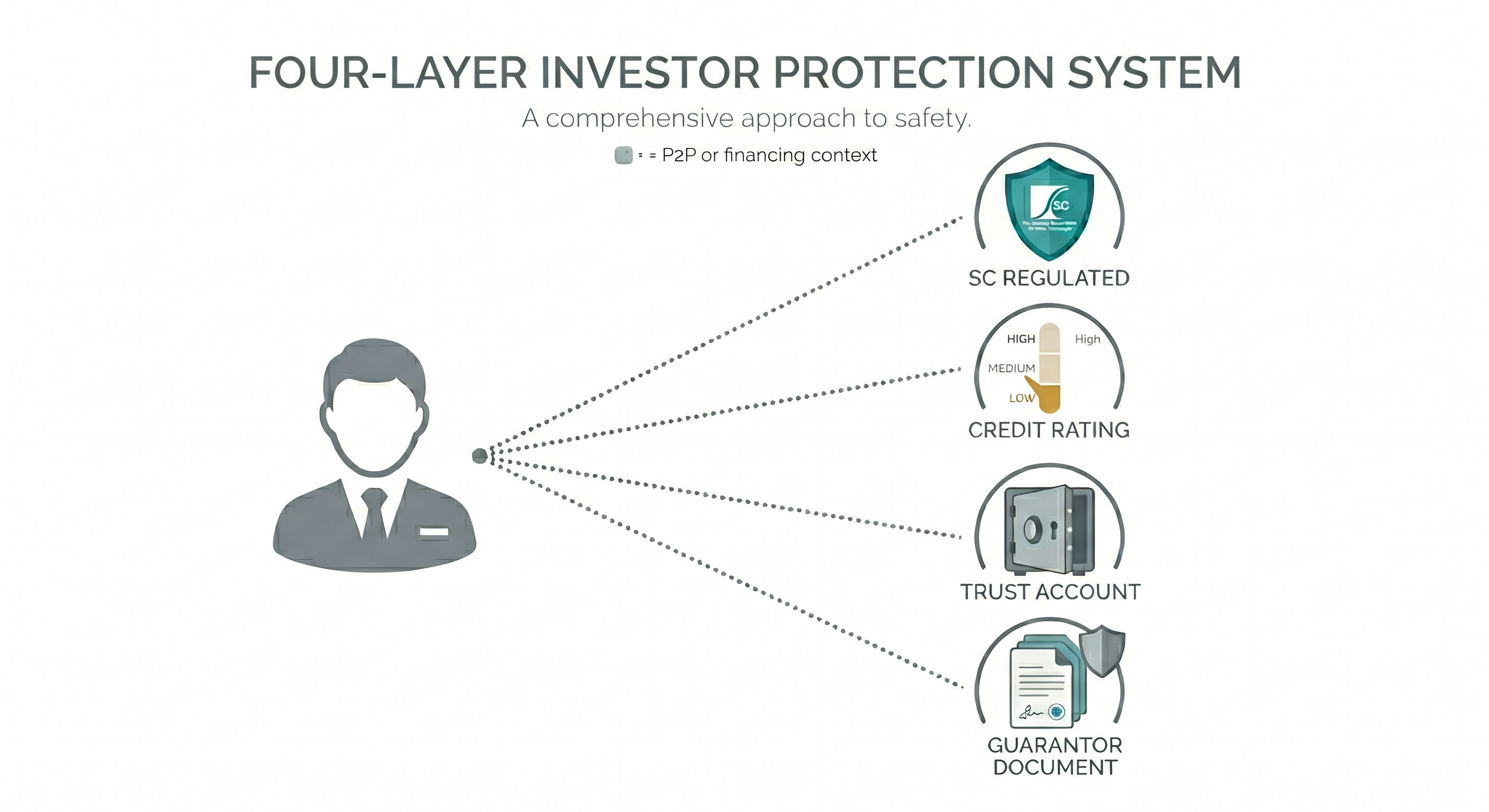
Image: Investor protection on microLEAP: SC, credit rating, trust account, guarantor.
Unlike an FD, P2P is not PIDM-insured, so your capital carries some default risk. microLEAP manages that risk through credit ratings, guarantors, and segregated trust accounts, and it is regulated by the Securities Commission Malaysia (SC) as a Recognised Market Operator (RMO).
- Not PIDM-insured. Unlike a fixed deposit, P2P financing carries some element of default risk. That is the honest starting point.
- Credit rating (Low, Medium, or High) on every Note lets you choose the risk level you are comfortable with.
- 0.25% default rate on microLEAP, the lowest among SC-regulated P2P platforms, reflecting strict issuer screening.
- Investor funds held in segregated trust accounts by Universal Trustee (Maybank Trustees Berhad), separate from the operator's own money.
- Personal or corporate guarantors on all Investment Notes.
- Spread across several Notes to reduce the impact of any single default.
- SC recommends retail investors keep total P2P financing within RM50,000 at any time.
You can learn how P2P financing works and how risk is managed on microLEAP before committing any funds.
Read: Is P2P Financing Safe in Malaysia? SC Regulation Explained.
How do you use P2P alongside your fixed deposit and unit trust?
P2P financing works best as a complement to your existing fixed deposit and unit trust, not a replacement for either.
Keep your emergency buffer in a fixed deposit where it is secure and PIDM-insured. For longer-term goals, a unit trust is a good investment in Malaysia if you want managed market exposure, though returns vary by fund, fees reduce your net return, and capital is never guaranteed. P2P financing fills a different gap: higher-return potential with money you can commit for the Note tenor. You add alongside. You do not switch.
You can browse live Investment Notes and diversify across sectors, risk levels, and tenors.
How to start investing in P2P financing with microLEAP
The barrier to starting is lower than most people realise.
Why does the RM10 minimum investment matter?
RM10 removes the biggest reason people delay: the belief that you need a large amount to start.
Traditional investment products such as unit trusts often require an initial investment of several hundred ringgit, while building meaningful exposure to stocks typically requires even more capital. This can be a barrier for many first-time investors.
With Investment Notes starting from just RM10 per Note, Investors can begin with a small amount, diversify across multiple opportunities, and gain firsthand experience with the investment process, including receiving monthly repayments. This allows them to build confidence gradually while maintaining minimal initial exposure before deciding to invest more.
See how investing works on microLEAP before you commit any funds.
Conclusion
A fixed deposit gives you security. A unit trust gives you managed market exposure. P2P financing on microLEAP offers the potential for higher returns while allowing you to start investing from as little as RM10. P2P is not capital-guaranteed and comes with some element of default risk, managed through credit ratings, personal guarantors, and segregated trust accounts. The goal is not to choose one and disregard the others. Rather, it is to build a balanced portfolio where your money is both protected and given opportunities to grow.
If you have been keeping most of your savings in fixed deposits, there is no need to move everything. With microLEAP, you can start exploring P2P financing alongside your existing investments. This allows you to gain experience, understand how the platform works, and build confidence before deciding whether to invest more.
Please note that all investments carry risk, including the possibility of delayed repayments and default. Returns are not guaranteed. Understand how each structure works before making any decision.