Key takeaways
- Shariah-compliant P2P investing on microLEAP uses profit-sharing through Sale-based contracts, not interest, with the profit rate declared upfront in each Investment Note.
- Notes on microLEAP offer returns of up to 18% p.a. depending on the Note, and the platform reports a net average return of 16% p.a. Returns are not guaranteed and capital is at risk.
- What an Investor earns depends on the risk grade of the Issuer, the tenor of the Note, Issuer repayment performance, and how widely the Investor diversifies.
- Shariah compliance governs how a contract is structured. It does not remove business risk, repayment risk, or the possibility of losing capital.
- An Investor can start from RM10 per Shariah-compliant Investment Note, subject to eligibility and the applicable terms.
Introduction
If you have already accepted that P2P investing can be Shariah-compliant, the next question is a practical one: is it worth it? You know the structure is permissible. Now you want the numbers, the risks, and a clear sense of what a realistic return looks like.
This article answers that. It explains how profit-sharing works in Islamic P2P investing, what returns an Investor can realistically expect on microLEAP, what drives those returns up or down, and the risks that sit alongside them. It closes with how to start.
If you are still exploring whether P2P investing is Shariah-compliant in the first place, see Is P2P Investing Shariah-Compliant? Shariah-Compliant Financing in Malaysia Explained.
How does profit-sharing work in Islamic P2P investing?
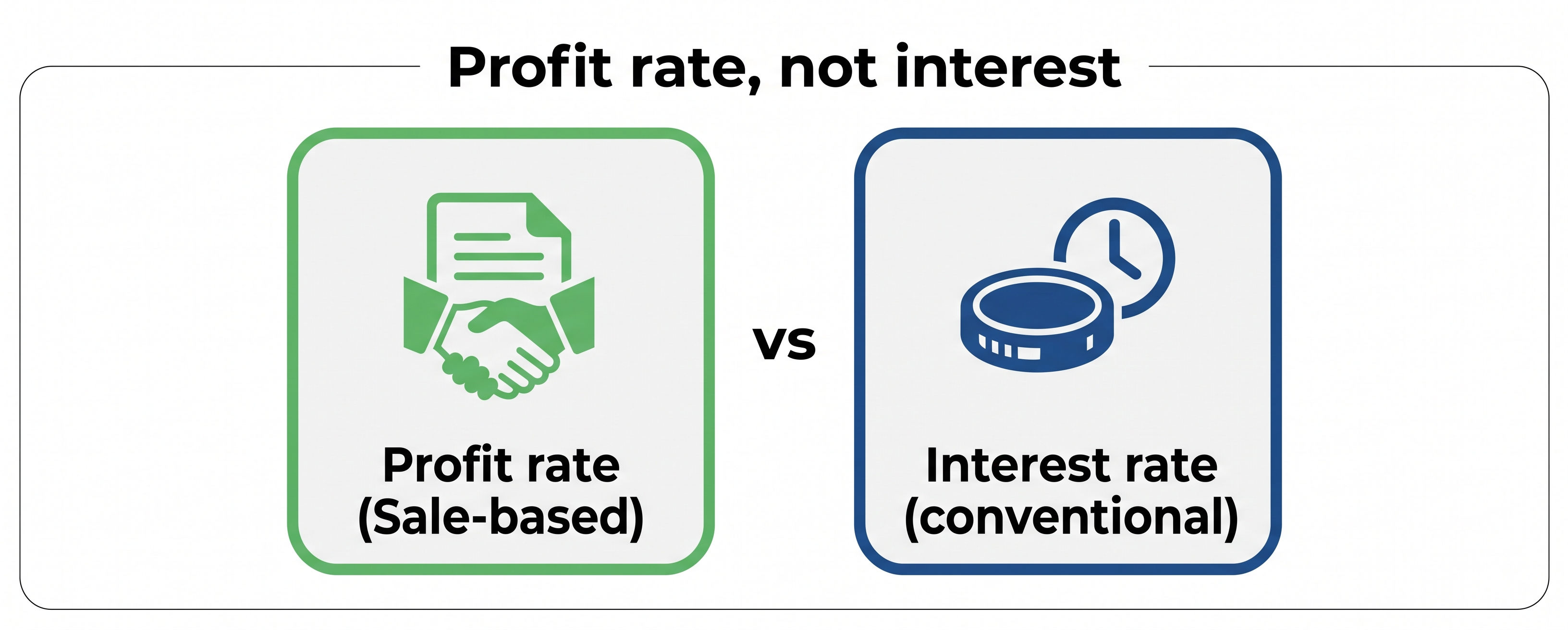
Image: A profit rate in a Sale-based contract versus a conventional interest rate.
Conventional investing pays interest, a charge on money lent over time. Islamic P2P investing does not work that way. The return comes from a profit arrangement built into the contract, not from interest on a loan.
On microLEAP, Shariah-compliant financing is structured through Sale-based contracts. The profit rate is declared upfront in the Investment Note, so both the Investor and the Issuer know the terms from the start, before any money is committed.
In practice, this means the return is defined before the Investor commits, rather than accruing as a charge on borrowed money. When an Investor funds a Note, the profit they can expect is already stated in the Note's terms, alongside the tenor and the risk grade. There is nothing to work out after the fact.
The platform's Shariah framework is endorsed by Masryef Advisory, which conducts a yearly Shariah audit of the framework rather than certifying each individual Note. This gives the structure independent oversight at the framework level.
One point matters throughout: Shariah compliance describes how the contract is built. It does not guarantee profit, repayment, or safety.
What is the difference between a profit rate and an interest rate?
A profit rate is the agreed return within a Sale-based contract, set and disclosed at the outset. An interest rate is a charge applied to a sum of money lent, accruing over time regardless of an underlying sale. The difference lies in the contract structure, not in the simple fact that a return is earned.
What returns can an investor realistically expect from Shariah-compliant P2P investing in Malaysia?
This is the question most Investors come for. On microLEAP, Shariah-compliant Investment Notes offer returns of up to 18% p.a. depending on the Note, and the platform reports a net average return of 16% p.a. across its Notes.
Two things need to be said clearly alongside those figures. First, returns are not guaranteed. They vary by Note, by the risk grade assigned to the Issuer, by tenor, and by how the Issuer actually performs during the financing period. Second, any return figure has to be read together with the risk. Capital is at risk, and a higher advertised return generally reflects a higher level of risk rather than better value.
The headline number, in other words, is a ceiling for the strongest-performing Notes, not a promise for every one.
All microLEAP figures in this article are as of 13 August 2026.
Factors that affect how much an investor earns
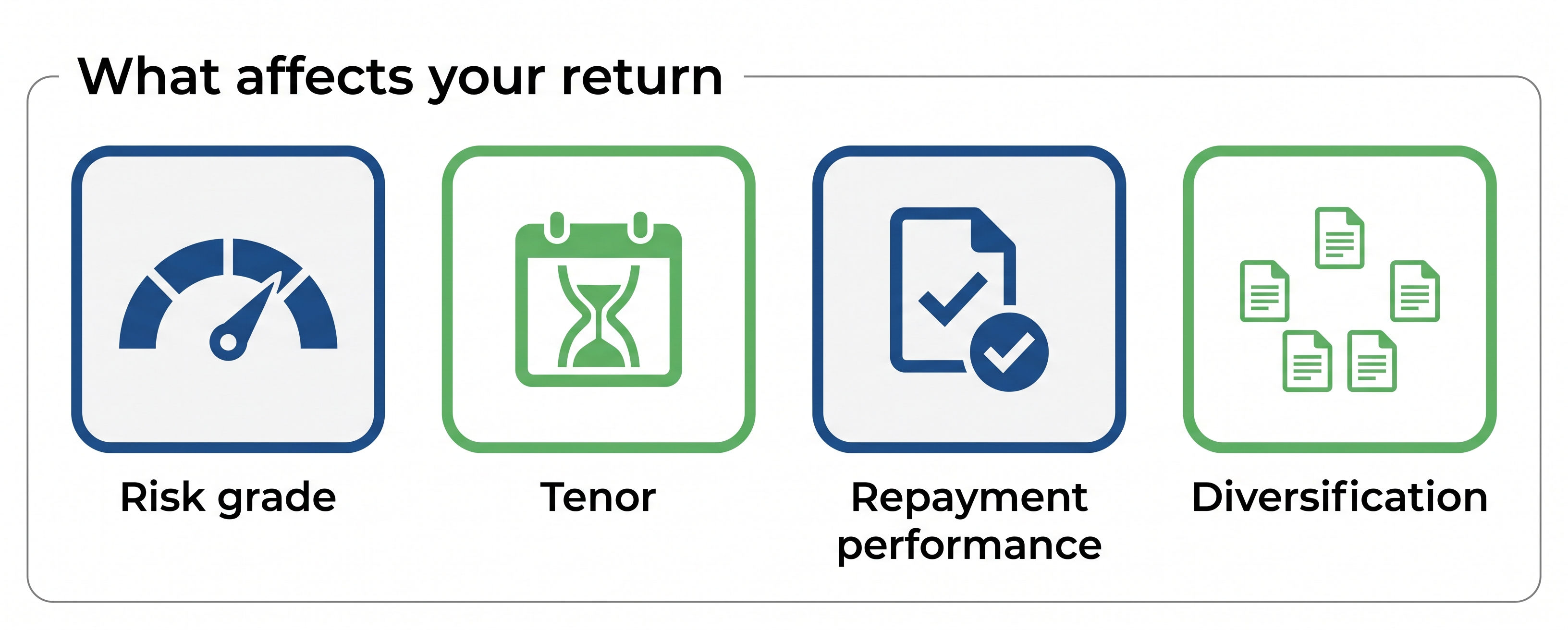
Image: Four factors that shape an investor's return.
Four factors shape the actual return an Investor sees:
- Risk grade of the Issuer. microLEAP grades Notes across low, medium, and high risk bands. Lower-risk Notes generally carry lower potential returns; higher-risk Notes carry higher potential returns and a higher chance of default.
- Tenor of the Investment Note. The financing period affects both the return profile and how long capital stays committed.
- Issuer repayment performance. Returns depend on the Issuer actually meeting repayments. Late payment or default reduces or removes the expected return.
- Diversification across multiple Investment Notes, sectors, tenors, and risk grades. Spreading capital rather than concentrating it in one Note reduces the impact of any single Issuer defaulting.
What risks affect returns in Shariah-compliant investing?
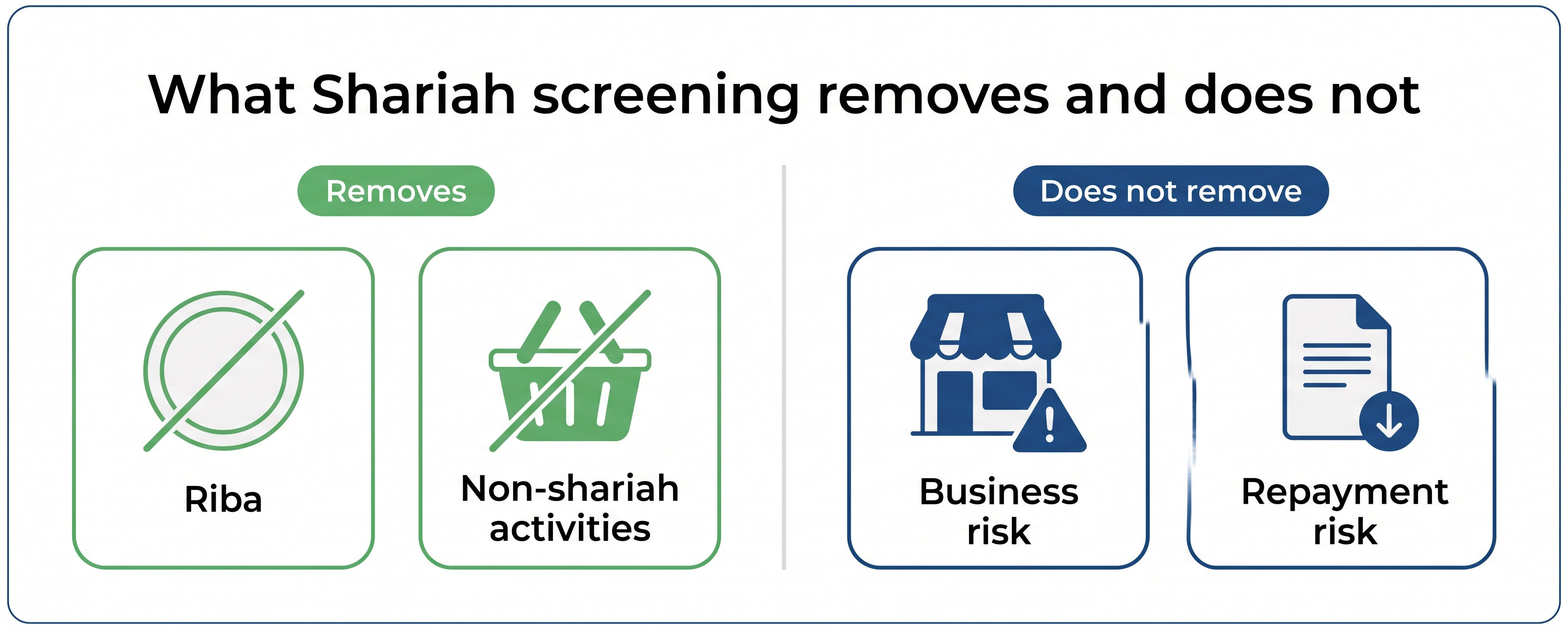
Image: Shariah screening removes riba and non-shariah activities, not risk.
A common assumption is that Shariah-compliant means safer. It does not. Shariah screening is about the structure of the contract, not the creditworthiness of the Issuer.
Screening removes riba and non-shariah business activities. It does not remove business risk or repayment risk. A Shariah-compliant Issuer can still run into trouble and fail to repay, exactly like any other business.
microLEAP applies several safeguards before and during financing:
- Credit assessment of every Issuer before a Note is listed
- A minimum of two personal guarantors on financing
- A corporate guarantee where necessary
- A default defined as no repayment for six consecutive months
These measures provide a layer of protection, but they are not a guarantee. If an Issuer defaults, an Investor may lose part or all of the capital placed in that Note. As a guide to managing exposure, the Securities Commission Malaysia advises retail Investors to limit their total P2P investment to RM50,000 at any one time.
How can an investor start Shariah-compliant investing in Malaysia?
Getting started is straightforward. The minimum is RM10 per Shariah-compliant Investment Note, which lets an Investor spread even a modest amount across several Notes.
On the platform, Shariah-compliant Notes can be filtered from Conventional ones, along with filters for sector, tenor, and risk rating. Before committing, an Investor can see the profit rate, tenor, risk grade, and Issuer information for each Note, so the decision is made on disclosed terms rather than guesswork. Repayments are credited to an Investor's Available Balance according to each Note's repayment structure, from where funds can be withdrawn or reinvested into new Notes, subject to platform procedures and the applicable terms.
microLEAP PLT is registered with the Securities Commission Malaysia as a Recognised Market Operator (RMO). Any platform's status can be checked directly on the SC register.
Investing is subject to eligibility, platform terms, and the terms of each Note. For a full step-by-step walkthrough, see How to Start Investing in P2P with as Little as RM10.
To weigh up platforms before committing, see How to Choose a P2P Investment Platform in Malaysia: What to Look For.
Frequently asked questions about Shariah-compliant investing in Malaysia
What is the average return for Shariah-compliant investments in Malaysia?
There is no fixed or guaranteed average. On microLEAP, Notes offer returns of up to 18% p.a. depending on the Note, and the platform reports a net average return of 16% p.a. Actual returns vary by Note and are not guaranteed.
Can an investor lose money in Islamic P2P investing?
Yes. If an Issuer defaults, an Investor can lose part or all of the capital in that Note. Shariah compliance does not protect against default or loss.
Is Shariah-compliant investing open to non-Muslim investors?
Yes. Both Shariah-compliant and Conventional Investment Notes are available to all Investors on microLEAP, regardless of faith.
How is a Shariah-compliant Investment Note different from a conventional one on microLEAP?
The difference is in the contract structure. A Shariah-compliant Note uses a Sale-based contract and a declared profit rate; a Conventional Note uses an interest-based structure. Both carry the same category of investment risk, and a Shariah-compliant Note is not inherently safer.
Does a higher profit rate always mean a better investment?
No. A higher profit rate generally reflects higher investment risk rather than better value. An Investor should weigh the risk grade, tenor, Issuer profile, and diversification, not the expected return alone.
Conclusion
For an Investor who has already accepted that P2P investing is permissible, the real question is whether it delivers. On microLEAP, Shariah-compliant Notes offer returns of up to 18% p.a. depending on the Note, structured through profit-sharing rather than interest.
The structure differs from conventional investing. The risk does not. Returns are not guaranteed, capital is at risk, and the return an Investor actually earns depends on the Note, the Issuer, and how well the portfolio is diversified.
All investments carry risk. Please refer to microLEAP's terms and conditions for full terms and risk disclosures.
Regulatory and advertising disclosures
This advertisement has not been reviewed by the Securities Commission Malaysia.
microLEAP PLT is registered with the Securities Commission Malaysia as a Recognised Market Operator to operate a P2P financing platform. Registration with the SC does not constitute a recommendation or endorsement by the SC of microLEAP, its products, services or any Investment Note.
P2P Investment Notes are not capital-guaranteed or protected by PIDM. Investors may experience delayed repayment, Issuer default and partial or total loss of principal. Returns are not guaranteed.