Key takeaways
- Potential returns are not guaranteed. The stated profit rate on a P2P Investment Note is disclosed before an investment is made. However, actual returns depend on the Issuer’s ability to fulfil its repayment obligations in full and on time.
- Look beyond the profit rate. Tenor, risk grade, repayment structure and the Issuer’s repayment performance are key considerations when assessing an Investment Note. Focusing solely on the stated profit rate may lead Investors to underestimate the risks involved.
- Your capital is committed for the investment period. P2P Investment Notes are not liquid instruments. Investors generally cannot withdraw their invested funds on demand and must wait for repayments in accordance with the Note’s terms, subject to the possibility of delays or default.
- P2P investments carry inherent risks. Investment Notes are not protected by Perbadanan Insurans Deposit Malaysia (PIDM) or the Capital Market Compensation Fund (CMCF). Investors remain exposed to the risk of delayed repayments and default, regardless of the risk grade assigned to a Note.
- Repayment structure affects cash flow. The repayment structure determines when Investors receive their principal and profit. Under a monthly repayment structure, both principal and profit are repaid throughout the tenor. Under a balloon structure, profit is paid monthly while principal is repaid at maturity. Under a bullet structure, both principal and profit are repaid in a single lump sum at maturity.
Introduction
When comparing two P2P Investment Notes with different profit rates, it may be tempting to choose the one offering the higher return. However, the stated profit rate is only one part of the equation. The actual outcome of an investment also depends on the risks involved, how long your funds are committed and when repayments are due.
microLEAP is registered with the Securities Commission Malaysia (SC) as a Recognised Market Operator (RMO) to operate a peer-to-peer (P2P) financing platform. On the platform, businesses seeking financing are referred to as Issuers, while Investors provide funding through Investment Notes.
This article examines four key factors that influence the potential returns and cash flow of a P2P Investment Note: profit rate, risk grade, tenor and repayment structure. Understanding how these factors interact can help Investors make more informed decisions, rather than relying on the stated profit rate alone.
For a broader perspective on whether P2P financing aligns with your investment objectives and income expectations, see Is P2P Investing Worth It for Passive Income in Malaysia?
What are the main factors that affect your P2P investment returns?
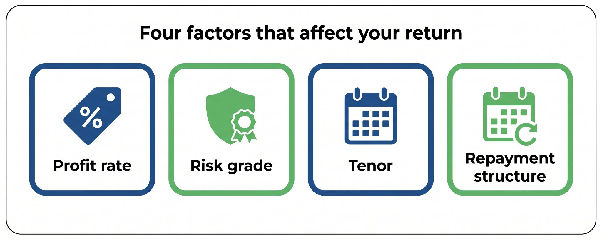
Image: The four factors that affect P2P investment returns on microLEAP.
The potential return on a P2P Investment Note is shaped by four interrelated factors: profit rate, risk grade, tenor and repayment structure. Each influences the potential return, the level of credit risk assumed and the timing of cash flows. Understanding these factors together provides a more comprehensive basis for evaluating an Investment Note than comparing profit rates alone.
How does the profit rate affect your P2P investment returns?
The profit rate represents the stated potential return on an Investment Note and is disclosed before an investment is made. However, it is not a guaranteed return. The actual amount received depends on the Issuer’s ability to fulfil its repayment obligations in accordance with the Investment Note’s terms.
Generally, a higher profit rate reflects a higher level of assessed credit risk. Investment Notes with higher stated potential returns are intended to compensate Investors for taking on greater credit risk, which may include a higher likelihood of delayed repayments or default.
A higher profit rate should therefore not be viewed as an indication of a better investment. Instead, Investors should assess whether the potential return adequately compensates for the risks involved.
The key consideration is not simply how much an Investment Note offers, but whether the potential return justifies the associated risk.
How does the risk grade affect your P2P investment returns?
Risk grades provide an indication of the Issuer’s assessed credit risk at the time an Investment Note is listed. On microLEAP, Investment Notes are classified into three risk bands:
- Low Risk (LR1-LR3): Generally associated with lower assessed credit risk and lower stated potential returns.
- Medium Risk (MR4-MR7): Generally associated with moderate assessed credit risk and moderate stated potential returns.
- High Risk (HR8-HR10): Generally associated with higher assessed credit risk and higher stated potential returns.
The risk grade serves as a reference point when evaluating an Investment Note, but it is not a guarantee of repayment. A Low Risk classification does not mean an investment is risk-free. Investors across all risk bands remain exposed to potential repayment delays, default and loss of capital.
Investors should therefore consider the risk grade alongside the profit rate, rather than evaluating either factor in isolation. A higher stated return may appear attractive, but it should be assessed against the corresponding credit risk and the Investor’s own risk tolerance.
For a more detailed explanation, see Understanding Credit Ratings on P2P Platforms in Malaysia.
How does the tenor affect your P2P investment returns?
The tenor refers to the financing period during which the Issuer is expected to repay the financing. It varies according to the financing product and is disclosed in the Fact Sheet of each Investment Note.
The tenor affects how long an Investor’s capital remains committed. An Investment Note with a longer tenor ties up funds for a longer period, limiting the Investor’s ability to redeploy that capital into other opportunities before maturity.
It is also important to distinguish between the stated tenor and the actual repayment timeline. Although an Investment Note has a specified maturity date, repayments may be delayed if the Issuer is unable to meet its obligations on time.
P2P Investment Notes are not liquid instruments and cannot be withdrawn on demand. Investors should consider their financial commitments, liquidity needs and investment horizon before committing funds.
Before investing, consider whether you can afford to have your capital tied up for the full tenor, including the possibility of repayment delays.
How does the repayment structure affect your P2P investment returns?
The repayment structure determines when Investors receive their principal and profit throughout the tenor of an Investment Note. microLEAP offers three repayment structures, each with a different cash flow profile.
- Monthly (Standard): Principal and profit are repaid monthly throughout the tenor. Investors receive portions of their invested capital alongside profit as repayments are made.
- Balloon: Profit is paid monthly, while the principal is repaid in a lump sum at maturity, together with the final month’s profit. The principal therefore remains committed for the duration of the tenor.
- Bullet: No repayments are made during the tenor. The total principal and profit are repaid in a single lump sum at maturity, subject to the Issuer fulfilling its repayment obligations.
The repayment structure influences when Investors receive their funds and how much capital remains outstanding throughout the investment period.
Investors should consider which repayment structure best aligns with their cash flow requirements and investment objectives. Those who prefer to receive capital progressively may favour monthly repayments, while those comfortable with receiving their funds at maturity may consider balloon or bullet structures.
Regardless of the structure selected, the scheduled repayment terms do not eliminate the risk of delayed payments or default.
What happens to your P2P investment returns if an Issuer defaults?
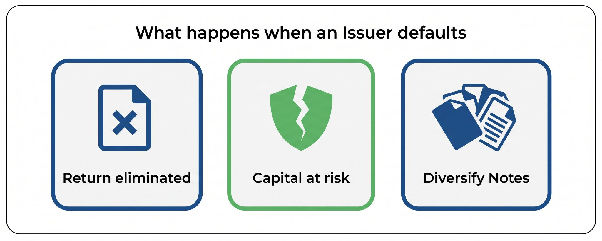
Image: What happens when an Issuer defaults on microLEAP.
An Issuer default can significantly affect the outcome of a P2P investment. Instead of receiving the stated potential return, Investors may receive less than expected or lose part or all of the capital invested in the Investment Note. Unlike a delayed repayment, a default introduces the risk that the Issuer may be unable to fulfil its repayment obligations.
The definition of default used for reporting purposes is set out on the microLEAP platform. As at 12 October 2026, microLEAP reports a default rate of 0.23%. Investors should review the applicable definition and reporting methodology when interpreting this figure, as default rates may be calculated differently across platforms.
A default can reduce or eliminate the potential profit from an Investment Note and may result in a loss of principal. While recovery efforts may be pursued, the amount ultimately recovered and the time required to recover funds depend on the circumstances of the case and the outcome of those efforts.
P2P Investment Notes are not bank deposits and are not protected by Perbadanan Insurans Deposit Malaysia (PIDM) or the Capital Market Compensation Fund (CMCF). Investors should therefore recognise that their capital is exposed to credit risk, including the possibility of partial or total loss.
Directors and/or shareholders of an Issuer may be required to provide a personal guarantee and indemnity as part of the financing arrangements. However, the existence of a personal guarantee does not assure repayment. Recovery depends on the applicable contractual terms, the guarantor’s ability to meet their obligations and the outcome of any enforcement action.
The Securities Commission Malaysia (SC) encourages retail Investors to limit their total investment exposure across P2P financing platforms to a maximum of RM50,000 at any one time as a risk-management measure. Retail Investors should also be mindful of the additional risks associated with investing beyond this threshold.
Diversification is another important consideration. Spreading investments across different Investment Notes, business sectors, tenors and risk grades can help reduce the impact of an individual Issuer’s default on an overall portfolio. However, diversification does not eliminate credit risk or guarantee that losses will be avoided.
Ultimately, Investors should assess both the potential returns and the possibility of loss before committing funds. Understanding a platform’s reported default rate, recovery practices and risk disclosures can help Investors make more informed decisions when evaluating P2P investment opportunities.
For a closer look at how to interpret default rates and assess platform-level risks, see How to Assess Risk & Default Rates When Choosing a P2P Platform in Malaysia.
How to use these four factors when selecting a P2P Investment Note
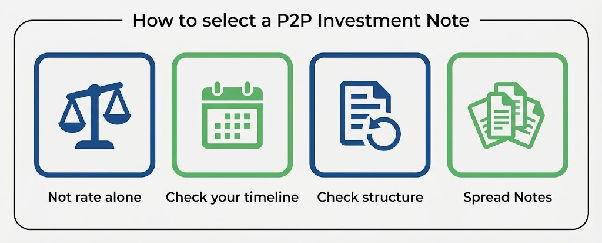
Image: How to select a P2P Investment Note using four key factors.
Selecting a P2P Investment Note requires more than comparing stated profit rates. Investors should assess the profit rate, risk grade, tenor and repayment structure together, alongside the Issuer’s information, to determine whether an investment aligns with their financial objectives, risk tolerance and liquidity needs.
- Look beyond the profit rate. A higher stated profit rate on a High Risk Investment Note reflects a different credit risk profile from a lower rate on a Low Risk Investment Note. Investors should consider whether the potential return adequately compensates for the risks involved, bearing in mind that returns are not guaranteed and capital may be at risk.
- Consider your investment horizon. The tenor determines how long your capital is expected to remain committed. A longer-tenor Investment Note may be unsuitable if you anticipate needing access to your funds sooner, particularly as P2P investments cannot be withdrawn on demand and repayments may be delayed.
- Understand the repayment structure. Monthly Investment Notes return principal and profit progressively throughout the tenor. Balloon Investment Notes pay profit monthly, with the principal and final month's profit due at maturity. Bullet Investment Notes make no scheduled payments during the tenor, with the total principal and profit due in a single lump sum at maturity. Consider which structure best suits your cash flow needs, while recognising that scheduled repayments are subject to the Issuer meeting its obligations.
- Diversify your investments. Spreading funds across multiple Investment Notes, business sectors, tenors and risk grades can help reduce the impact of any single Issuer defaulting on your overall portfolio. However, diversification does not eliminate the risk of loss.
Before committing funds, review the profit rate, risk grade, tenor, repayment structure and available Issuer information disclosed on the platform. Evaluating these factors collectively can help you make more informed investment decisions, although it cannot guarantee a particular outcome.
For practical guidance on spreading your investments across Investment Notes, sectors and risk grades, see How to Diversify Your P2P Investments to Manage Risk.
Frequently asked questions about P2P investment returns in Malaysia
What returns can P2P investing offer in Malaysia?
The stated potential return on a P2P Investment Note is disclosed before an investment is made. However, it is not a guaranteed or necessarily expected return. It represents the profit the Issuer is contractually obligated to pay, subject to the terms of the Investment Note and the Issuer fulfilling its repayment obligations. Actual returns vary depending on the Investment Note, its risk grade and the Issuer’s repayment performance. If an Issuer defaults, Investors may receive less than the stated potential return or lose part or all of their invested capital.
Why does a higher P2P profit rate not always mean a better return?
A higher profit rate generally reflects a higher level of assessed credit risk and is intended to compensate Investors for taking on that additional risk. However, a higher stated rate does not guarantee a better investment outcome. If an Issuer fails to meet its repayment obligations, the actual return may be reduced or eliminated. Consequently, a High Risk Investment Note offering a higher profit rate may deliver a lower actual return than a Low Risk Investment Note if repayment difficulties or default occur.
What is the difference between Monthly, Balloon and Bullet repayment in P2P financing?
The three repayment structures determine when Investors receive their principal and profit. Monthly (Standard) repayments return portions of the principal and profit each month throughout the tenor. Balloon repayments provide monthly profit payments, with the principal and final month's profit repaid in a lump sum at maturity. Bullet repayments involve no scheduled payments during the tenor, with the total principal and profit due in a single lump sum at maturity. All repayments remain subject to the Issuer fulfilling its obligations.
Can I withdraw from or exit a P2P Investment Note before its tenor ends?
No. Investment Notes on microLEAP cannot be withdrawn on demand before maturity, and there is no secondary market on the platform for Investors to sell their Investment Notes. Funds therefore remain committed for the duration of the tenor, subject to the applicable terms and actual repayment circumstances. Investors should consider their liquidity needs before committing funds.
Can I lose money on a Low Risk P2P Investment Note?
Yes. A Low Risk classification (LR1 to LR3) reflects the assessed credit risk at the time the Investment Note is listed. It does not guarantee repayment or eliminate investment risk. An Issuer may still experience financial difficulties, delay repayments or default. Investors may consequently lose part or all of the capital invested, regardless of the assigned risk grade.
What happens to my P2P investment returns if an Issuer misses a payment?
A missed payment may delay the receipt of principal or profit and affect the actual return on an Investment Note. If the Issuer subsequently fulfils its repayment obligations, some or all of the outstanding amounts may eventually be recovered, depending on the circumstances and applicable terms. If the Issuer is unable to repay, the Investment Note may enter default, potentially resulting in reduced returns and partial or total loss of capital. Recovery efforts may be pursued, but neither repayment nor the timing of recovery is guaranteed.
Conclusion
Evaluating a P2P Investment Note requires more than comparing profit rates. The potential return and associated risks are shaped by four interconnected factors: profit rate, risk grade, tenor and repayment structure. Considering these factors alongside the Issuer’s information can help Investors make more informed decisions and assess whether an Investment Note aligns with their financial objectives, risk tolerance and liquidity needs.
Before committing funds, Investors should review all available information disclosed on the microLEAP platform and consider diversifying across Investment Notes, business sectors, tenors and risk grades. While diversification can help reduce the impact of an individual Issuer defaulting on an overall portfolio, it does not eliminate the risk of loss.
P2P Investment Notes are not bank deposits and are not protected by Perbadanan Insurans Deposit Malaysia (PIDM) or the Capital Market Compensation Fund (CMCF). All P2P investments carry inherent risks, including delayed repayments, default and the potential loss of capital. Investors should carefully review microLEAP’s Terms and Conditions and applicable risk disclosures before making an investment decision.
Regulatory and advertising disclosures
This advertisement has not been reviewed by the Securities Commission Malaysia.
microLEAP PLT is registered with the Securities Commission Malaysia as a Recognised Market Operator to operate a P2P financing platform. Registration with the SC does not constitute a recommendation or endorsement by the SC of microLEAP, its products, services or any Investment Note.
P2P Investment Notes are not capital-guaranteed or protected by PIDM. Investors may experience delayed repayment, Issuer default, and partial or total loss of principal. Returns are not guaranteed.