
Key takeaways
- A default rate generally refers to the proportion of Investment Notes on a platform where Issuers have failed to make repayments within a specified period. However, definitions of “default” can differ between platforms, which means reported figures may not always be directly comparable.
- Before comparing default rates, Investors should understand how each platform defines a default, the date to which the figure relates, and the risk-grade composition of the underlying portfolio.
- As of 2 October 2026, microLEAP reports a default rate of 0.23%. The definition of default applied to this figure is set out on the microLEAP platform.
- A historical default rate can provide useful information about a platform’s past performance, but it is not a guarantee of future performance. The risk of loss remains with the Investor on each Investment Note.
- Default rates are only one factor to consider when assessing a P2P platform. Other considerations include SC registration, the platform’s track record, minimum investment amount, risk assessment methodology and transparency of risk disclosures.
Introduction
Investors comparing P2P platforms in Malaysia will often encounter a default rate. It is one of the most commonly cited metrics in P2P financing, but it can also be one of the most easily misunderstood.
A default rate can provide useful information when assessing a platform, but the figure alone does not tell the full story. How a platform defines a default, when the figure was last updated, and the types of Investment Notes included in the underlying portfolio can all affect how the number should be interpreted.
This article explains what a default rate is, why reported rates can differ between platforms, and what Investors should consider before comparing figures. It also uses microLEAP’s reported default rate as a worked example. No cross-platform comparisons are made in this article.
For an overview of common mistakes made by first-time P2P Investors and the risks they may create, see P2P Investing for First-Time Investors: Common Mistakes to Avoid.
What is a default rate in P2P investing?
A default rate is a measure of the proportion of Investment Notes on a platform where the Issuer has failed to make repayments within a defined period. An Issuer is the business that raises financing through the platform.
The definition of "default" is not necessarily the same across platforms. Each platform may define and measure a default differently, and the approach used can have a material effect on the default rate reported.
For this reason, Investors should not compare default rates in isolation. Before comparing figures across platforms, it is important to understand how each platform defines and measures a default, the period covered by the reported figure, and the Investment Notes included in the calculation.
A difference in reported default rates does not, by itself, indicate a difference in the underlying quality of the Issuers or Investment Notes. The methodology used to calculate the figure is an important part of understanding what the number represents.
Why do default rates vary between platforms?
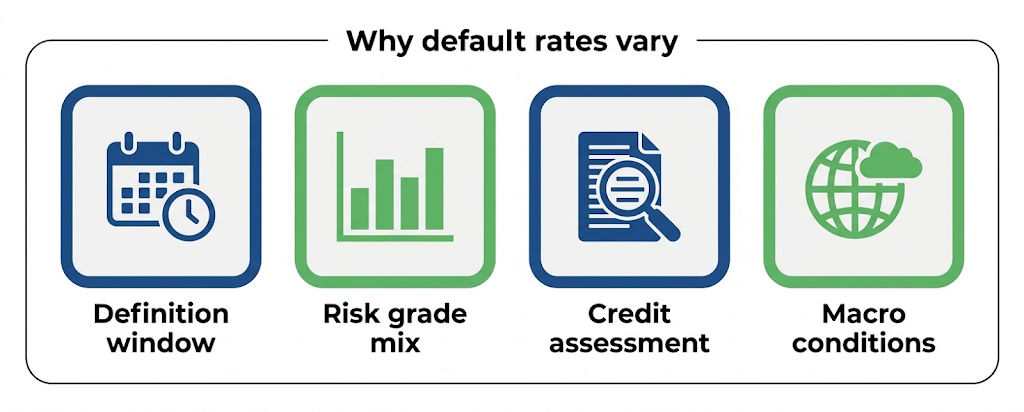
Image: Why default rates vary between P2P platforms.
Default rates can vary between P2P platforms for several reasons, including how each platform defines a default, the types of Issuers it accepts, the composition of Investment Notes offered, and the credit assessment processes applied before a Note is listed.
Four factors are particularly relevant.
The definition window. Each platform may use a different definition to classify a Note as being in default. Even where Issuer repayment performance is the same, platforms applying different definitions may report different default rates.
The risk-grade mix. Investment Notes may carry different risk ratings, such as Low, Medium or High. A portfolio with a greater proportion of higher-risk Notes may have a different default profile from one with a greater proportion of lower-risk Notes. The mix of Notes therefore provides important context when interpreting a platform’s overall default rate.
Credit assessment. The credit, financial and background checks applied before an Issuer is accepted can affect the composition of Notes available on a platform. Differences in assessment methodology and eligibility criteria may therefore contribute to differences in subsequent repayment and default experience.
Macroeconomic conditions. Economic conditions can affect Issuers’ ability to meet their repayment obligations. A default rate recorded during a period of relatively stable economic conditions may not necessarily reflect how repayment performance would change under different economic circumstances.
A default rate therefore needs to be considered in context. Understanding the methodology behind the figure, the composition of the Notes included, and the period covered can provide a clearer picture of what the reported rate represents.
What should an Investor check before comparing default rates?
Rather than comparing default rates across platforms at face value, Investors should first understand how each figure is calculated and the context behind it. Four areas are particularly important:
| What to check | Why it matters |
|---|---|
| How the platform defines default | The definition a platform uses to classify a Note as being in default can have a material effect on the reported rate, even where underlying repayment performance is the same. |
| The as-of date of the figure | A default rate from two years ago may not reflect more recent repayment performance or current portfolio conditions. |
| The risk-grade mix of the portfolio | The composition of Investment Notes by risk rating provides important context when interpreting an overall default rate. The same reported rate may have a different meaning depending on the underlying portfolio. |
microLEAP's reported default rate is 0.23% as of 2 October 2026, across Notes spanning Low, Medium and High risk grades. The definition of default applied to this figure is set out on the microLEAP platform.
A low historical default rate may provide an indication of past repayment performance, but it does not eliminate investment risk or guarantee future performance. Investors remain exposed to the risk of partial or total loss of capital on each Investment Note.
Why does a low default rate not guarantee future returns?
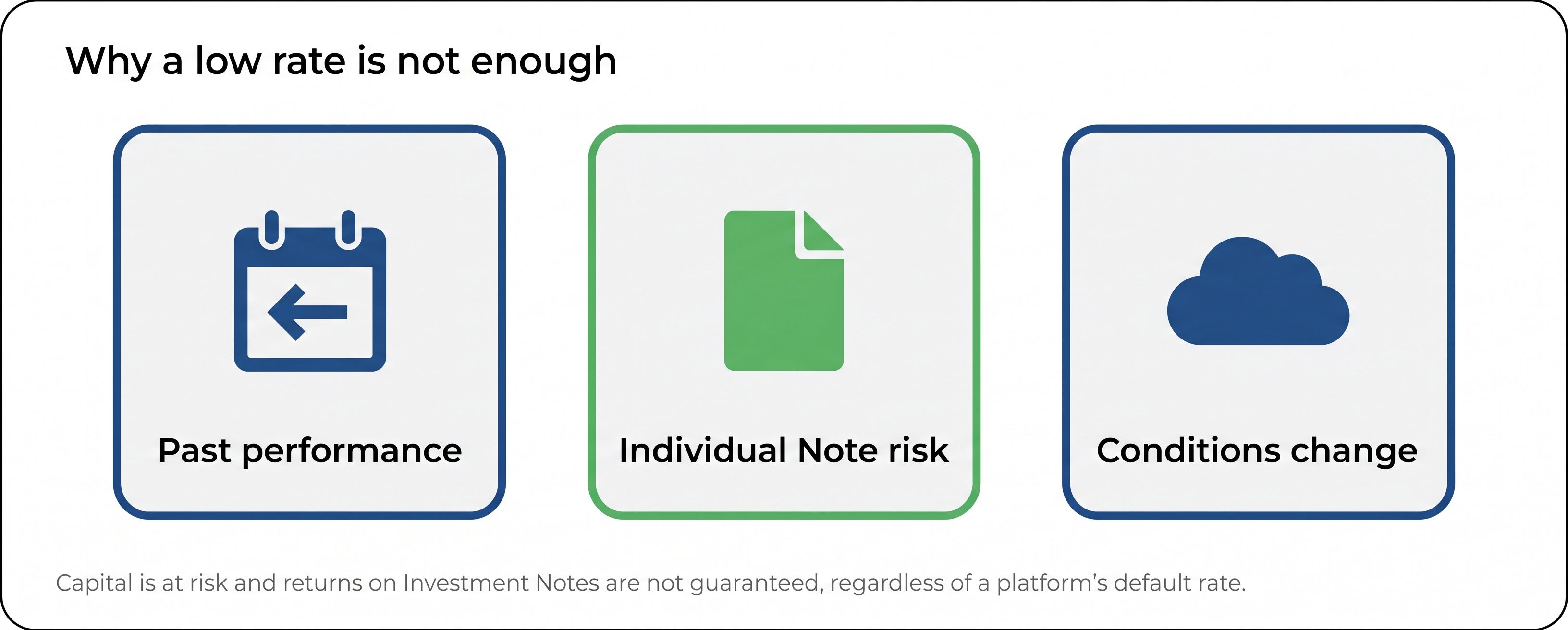
Image: Why a low default rate does not guarantee future returns.
A low historical default rate can provide useful information about past repayment performance, but it does not guarantee that future Investment Notes will perform in the same way.
Default rates reflect past performance under the economic and market conditions that existed during the period measured. Those conditions can change, and historical data may not fully reflect how a platform or its Issuers would perform under different circumstances.
Each Investment Note carries its own risk. A platform’s overall default rate does not protect an individual Note from default. An Investor holding a Note that defaults may incur a partial or total loss of capital, regardless of the platform’s overall reported default rate.
Economic conditions are another consideration. A default rate recorded during a period of relatively stable conditions may not indicate how repayment performance could change during an economic downturn, when some Issuers may face greater difficulty meeting their obligations.
The Securities Commission Malaysia (SC) encourages retail Investors to limit their total investment exposure across P2P platforms to a maximum of RM50,000 at any one time as a risk-management measure. The SC also advises retail Investors to be aware of the risks associated with investing beyond this threshold.
Capital is at risk, and returns on Investment Notes are not guaranteed. A platform’s historical default rate should therefore be considered as one part of an Investor’s assessment, rather than as an assurance of future performance.
How should an Investor use the default rate when choosing a platform?
The default rate is one data point among several when assessing a P2P platform. It should
not be viewed in isolation or used as the sole basis for deciding whether to invest.
Before drawing any conclusion from a reported figure, Investors should understand how the platform defines a default, the date to which the figure relates, and the risk-grade mix of the underlying portfolio.
The risk-grade mix behind the figure is also relevant. For example, a 0.23% default rate across Investment Notes spanning Low (LR1-LR3), Medium (MR4-MR7) and High (HR8-HR10) risk grades provides different context from the same rate reported for a portfolio concentrated in a single risk category. Investors should therefore consider both the headline default rate and the composition of the Notes from which it is derived.
A default rate is most useful when considered alongside other factors, including SC registration, track record, minimum investment requirements and the transparency of risk disclosures. No single metric provides a complete picture of a platform or the risks associated with its Investment Notes.
The default rate is one of several criteria Investors can consider when assessing a P2P platform. For a broader framework, see How to Choose a P2P Platform in Malaysia: A Checklist.
Frequently asked questions about P2P default rates and platform risk in Malaysia
What is considered a good default rate for a P2P platform?
There is no universal benchmark for what constitutes a “good” default rate. A lower historical rate may indicate stronger past repayment performance, but it needs to be considered alongside the platform’s definition of default, the date of the figure and the risk-grade mix of the underlying portfolio.
A reported rate without this context provides a limited basis for comparison.
Can a P2P platform have a low default rate and still lose money?
Yes. A platform’s overall historical default rate does not protect an individual Investment Note from defaulting. An Investor holding a Note that defaults may experience a partial or total loss of capital, regardless of the platform’s overall reported rate.
Capital is at risk on every Investment Note.
How does microLEAP define a default?
microLEAP's definition of default is set out on the platform. As of 2 October 2026, microLEAP reports a default rate of 0.23%. This is a historical figure and does not guarantee future repayment performance.
Is a low default rate enough to choose a P2P platform?
No single metric provides a complete picture of a P2P platform. In addition to the historical default rate, Investors may consider factors such as SC registration, track record, fee transparency, minimum investment amount, risk assessment methodology and the quality and transparency of risk disclosures.
Are P2P platforms in Malaysia regulated?
Yes. P2P financing operators in Malaysia are regulated by the Securities Commission Malaysia (SC) and must be registered as Recognised Market Operators (RMOs) under the applicable regulatory framework.
Investors can verify a platform’s regulatory status through the SC’s published information on RMOs. microLEAP PLT is registered as a RMO.
SC registration is an important regulatory check, but it should not be interpreted as an endorsement or guarantee of a platform’s performance or of any particular investment.
Can diversification reduce default risk?
Diversification can reduce the impact that an individual default has on an overall portfolio, but it cannot eliminate investment risk or prevent losses.
Investors may choose to spread investments across multiple Investment Notes, Issuers, sectors, tenors and risk grades. The purpose is to avoid excessive concentration in any single Note or Issuer, while recognising that each Investment Note remains subject to its own risks.
The SC also encourages retail Investors to limit their exposure to P2P investments to a maximum of RM50,000 at any one time as a risk-management measure.
Conclusion
A default rate can be a useful starting point when evaluating a P2P platform, but it is not a complete measure of investment risk.
The definition behind the figure, the date on which it was reported and the risk-grade composition of the underlying portfolio all provide important context. Two platforms reporting similar default rates may be measuring different things, making the figures difficult to interpret without understanding the methodology behind them. Reading the rate in context provides a more meaningful basis for assessing what the figure represents.
All investments carry risk. Investors should refer to microLEAP’s terms and conditions for the full terms and applicable risk disclosures.
For a broader discussion of the factors to consider when assessing P2P investing as a potential source of investment returns, see Is P2P Investing Worth It for Passive Income in Malaysia?
Regulatory and advertising disclosures
This advertisement has not been reviewed by the Securities Commission Malaysia.
microLEAP PLT is registered with the Securities Commission Malaysia as a Recognised Market Operator to operate a P2P financing platform. Registration with the SC does not constitute a recommendation or endorsement by the SC of microLEAP, its products, services or any Investment Note.
P2P Investment Notes are not capital-guaranteed or protected by PIDM. Investors may experience delayed repayment, Issuer default, and partial or total loss of principal. Returns are not guaranteed.