
Is P2P Investing Worth It for Passive Income in Malaysia?
Key takeaways
- P2P investing can generate returns, but it is not suitable for everyone. Whether it makes sense for an individual Investor depends on factors such as their financial circumstances, risk appetite, investment objectives and ability to commit funds for the relevant investment tenor.
- Potential returns can be attractive, but they come with risk. Returns on microLEAP Investment Notes can reach up to 18% p.a., depending on the Note’s risk rating and tenor. This is a stated potential return, not a guaranteed return. Investors may lose some or all of their invested capital.
- P2P investing is not entirely passive. Investors who select Notes manually need to assess available opportunities and keep track of their investments. microLEAP’s Auto-Invest feature can reduce the need for manual selection, but it does not eliminate investment risk or guarantee returns.
- P2P investing may be suitable for investors with surplus funds and a longer-term investment horizon. Investors should be comfortable with the possibility of borrower defaults and capital losses, and be able to leave their funds invested for the stated tenor. P2P investing should not be viewed as a guaranteed or sole source of income.
- Investors should also consider liquidity and protection. P2P investments are not covered by Perbadanan Insurans Deposit Malaysia (PIDM), Capital Market Compensation Fund (CMCF), or any deposit insurance scheme. Investment Notes are generally not liquid, meaning investors may not be able to withdraw their funds before the end of the stated tenor.
Introduction
For Malaysians looking to generate additional income from their investments, peer-to-peer (P2P) financing is one option that has gained attention. But before investing, two questions are worth considering: how realistic are the potential returns, and how hands-off is P2P investing in practice?
P2P investing can provide Investors with regular returns, depending on the performance of the underlying financing. However, whether it is worth considering depends on an Investor’s financial circumstances, investment objectives, risk tolerance and understanding of the risks involved. P2P investments are not savings products, and returns are not guaranteed.
This article looks at how returns work in P2P investing, what determines how hands-off the process can be, who may find it suitable, and the key considerations investors should weigh before getting started.
For a closer look at the common pitfalls faced by first-time Investors, see P2P Investing for First-Time Investors: Common Mistakes to Avoid.
How does P2P investing generate returns?
P2P Investors earn returns when the Issuers they fund make repayments on their Investment Notes. These repayments typically comprise both principal and profit. An Issuer is a business that raises financing through the P2P platform.
On microLEAP, Investment Notes offer stated potential returns of up to 18% p.a., depending on the Note’s risk rating and tenor. As at 11 September 2026, the platform reported a net average return of 16% p.a. across its Investment Notes. These figures are not guaranteed and actual returns will depend on the Investment Notes selected, as well as whether Issuers make their repayments on time.
Repayments are credited monthly to the Investor’s Available Balance. Investors can then withdraw the funds or reinvest them in new Investment Notes, allowing returns to be compounded over time if the funds are reinvested.
However, the potential for higher returns comes with investment risk. Returns depend on Issuers fulfilling their repayment obligations, and delays or defaults can affect an Investor’s returns and may result in a loss of capital. Returns are not guaranteed and capital is at risk.
What happens after repayments are received?
When an Issuer makes a repayment, the funds are credited to the Investor’s Available Balance. The Investor can then choose to withdraw the funds or reinvest them in new Investment Notes.
Reinvesting repayments can allow an Investor to compound returns over time, provided the funds are reinvested and the new Investment Notes generate returns. However, compounding is not automatic and depends on the Investor’s reinvestment decisions and the performance of subsequent investments.
Reinvestment also increases the amount of capital exposed to P2P financing. It does not guarantee higher overall returns, as future Investment Notes remain subject to the risk of delayed repayments, defaults and potential capital losses.
Is P2P investing considered passive income?
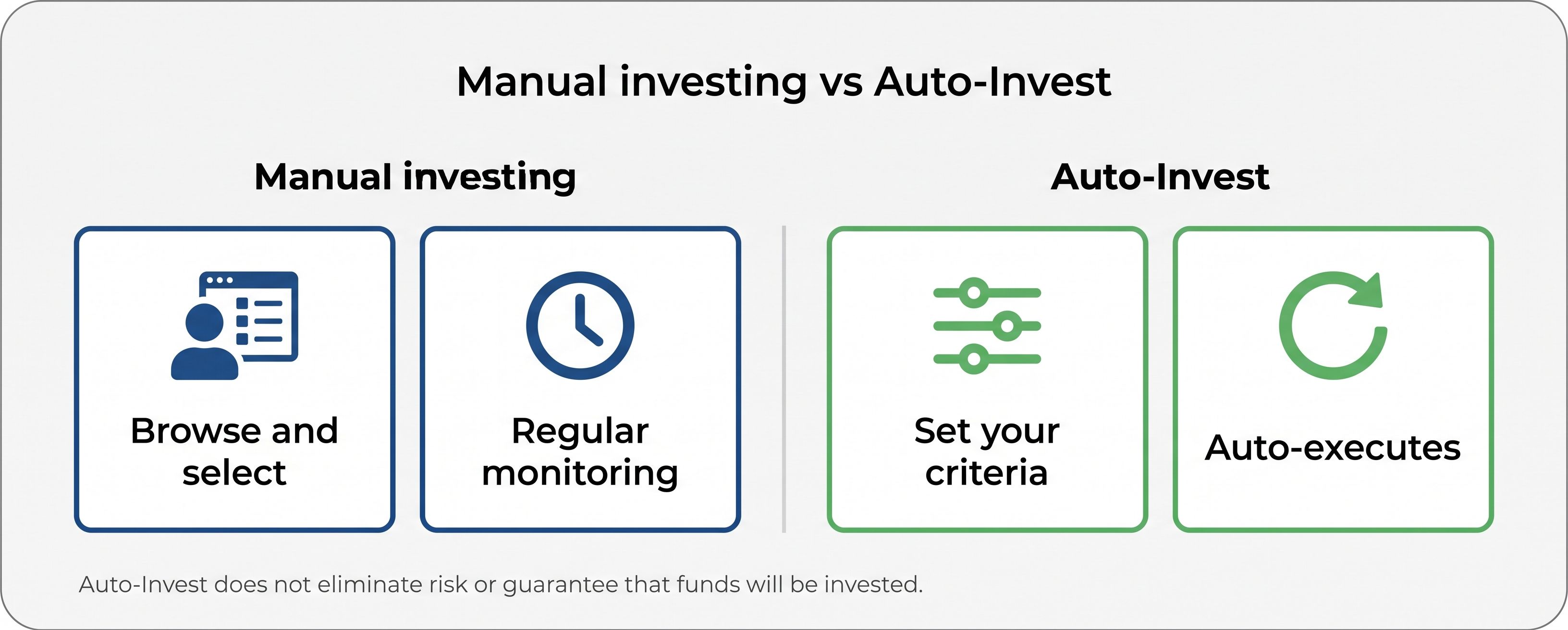
Image: Manual investing versus Auto-Invest on microLEAP.
P2P investing generally requires less active involvement than trading stocks or managing a property, but it is not entirely passive.
With manual investing, an Investor reviews the Funding List, selects Investment Notes and decides how much to allocate to each. This requires time to assess new opportunities and monitor the portfolio over the investment period.
For Investors who prefer a more automated approach, microLEAP’s Auto-Invest feature can automate the submission of investment instructions. Investors can set criteria such as credit risk rating, tenor, industry and the maximum amount to invest in each Note. The feature can reduce the need for day-to-day manual selection, but it does not eliminate investment risk or guarantee that funds will be invested.
Having Auto-Invest enabled does not guarantee an allocation. Investments remain subject to the availability of unfunded amounts, as well as factors such as oversubscription and other allocation considerations.
Investors should also review their portfolios periodically, including their Auto-Invest criteria, to ensure they remain aligned with their investment objectives and risk tolerance.
For more details on how the feature works, see Auto-Invest: Hands-Free P2P Investing on microLEAP.
Who is P2P investing suitable for?
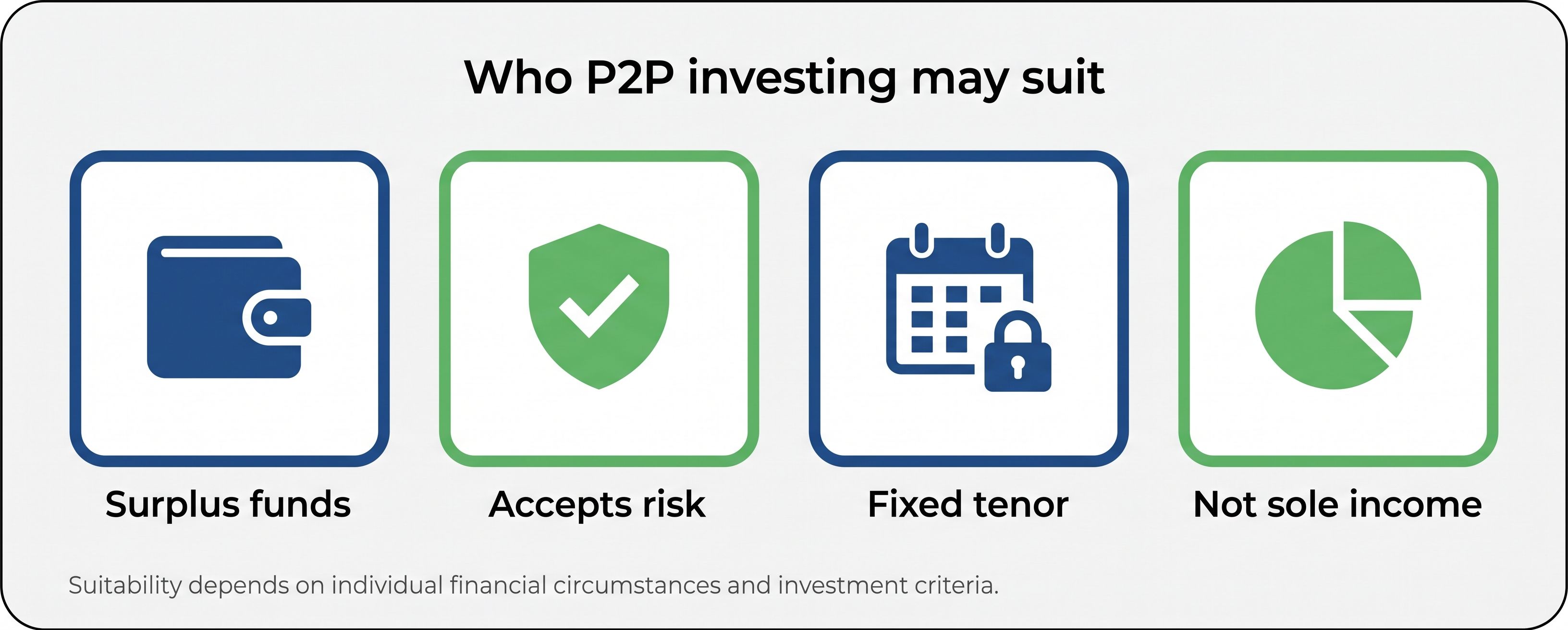
Image: Who P2P investing may be suitable for in Malaysia.
P2P investing may be worth considering for Investors who have surplus funds they can afford to put at risk, understand the possibility of borrower defaults, and are comfortable committing their capital for a fixed tenor. It may also appeal to Investors seeking higher potential returns than traditional savings or fixed-deposit products, provided they are prepared to accept the additional risks involved.
It is less likely to be suitable for Investors who need guaranteed access to their capital at any time or who require a predictable income without the possibility of shortfalls. P2P investments are subject to repayment and default risks, and returns are not guaranteed.
The Securities Commission Malaysia (SC) recommends that retail Investors cap their total P2P financing investments at RM50,000 at any one time.
Ultimately, whether P2P investing is appropriate depends on an Investor’s individual financial circumstances, investment objectives, risk tolerance and ability to withstand potential losses. This article is for informational purposes only and should not be construed as financial advice.
What are the risks of P2P investing?
As with any investment, P2P financing carries risks. The most significant is credit risk, which is the possibility that an Issuer may make late repayments or default on its financing obligations. This can reduce the expected return on an Investment Note and, in the event of a default, may result in a partial or total loss of the capital invested in that Note.
Capital is not guaranteed. P2P investments are also not covered by Perbadanan Insurans Deposit Malaysia (PIDM), Capital Market Compensation Fund (CMCF), or any deposit insurance scheme, unlike eligible deposits held with member banks.
Liquidity is another consideration. Investment Notes are not currently traded on a secondary market on microLEAP. Once invested, funds are generally committed for the stated tenor and cannot be withdrawn early. Investors should therefore consider when they will need access to their funds before investing.
Returns also vary between Investment Notes. A higher stated profit rate may reflect a higher level of credit risk rather than a better investment outcome. Investors should consider the Note’s risk rating, tenor and other relevant information alongside the stated profit rate when evaluating an investment opportunity.
Diversification can help manage concentration risk. Spreading investments across multiple Investment Notes, sectors, tenors and risk ratings can reduce the impact of any single default on a portfolio, although it does not eliminate the risk of loss.
For more information on evaluating platform risk and default rates, see How to Assess Risk & Default Rates When Choosing a P2P Platform in Malaysia.
Frequently asked questions about P2P investing for passive income in Malaysia
How much can I realistically earn from P2P investing in Malaysia?
It depends on the Investment Notes an Investor selects and whether Issuers make their repayments on time. On microLEAP, stated potential returns can reach 18% p.a., depending on the Note’s risk rating and tenor. As at 11 September 2026, the platform reported a net average return of 16% p.a. across its Investment Notes.
These figures are not guaranteed, and actual returns may vary. Past performance is not an indication of future results, and Investors may lose some or all of their capital.
Is P2P investing better than fixed deposits for passive income?
P2P investing offers higher potential returns than fixed deposits, but also carries a higher level of risk. Eligible deposits with PIDM member banks are protected by PIDM up to RM250,000 per depositor per member bank, subject to the applicable coverage terms. P2P investments are not covered by PIDM, and capital is at risk.
The two products also serve different purposes. The appropriate choice depends on an Investor’s financial circumstances, liquidity needs, investment objectives and tolerance for risk.
For a detailed comparison, see P2P Financing vs Fixed Deposit vs Unit Trust: Which Gives Better Returns in Malaysia?
Can I start P2P investing with a small amount?
Yes. The minimum investment on microLEAP is RM10 per Investment Note, subject to eligibility requirements and the platform’s terms.
A lower minimum investment may allow an Investor to spread a relatively small amount across multiple Investment Notes rather than concentrating it in a single Note. However, investing a smaller amount does not eliminate the underlying investment risks.
What happens to my returns if an Issuer misses a payment?
If an Issuer misses a scheduled repayment, the expected repayment may be delayed. If the Issuer subsequently defaults, the Investor may experience a partial or total loss of the capital invested in that Investment Note.
Investment Notes on microLEAP carry personal guarantees from Issuers. However, a guarantee does not mean that repayment is assured, and recovery in the event of default may depend on the circumstances and enforcement of the relevant guarantee.
Is P2P investing in Malaysia regulated?
Yes. P2P financing platforms in Malaysia operate within a regulatory framework established by the Securities Commission Malaysia (SC) and must be registered as Recognised Market Operators (RMO).
Investors can check a platform’s registration status on the SC’s register of recognised market operators. microLEAP PLT is registered as a Recognised Market Operator.
However, registration should not be interpreted as an endorsement of a platform’s investment products, performance or potential returns. It does not eliminate investment risk or guarantee returns.
Can I live entirely on P2P passive income?
P2P investing is generally better viewed as one component of a broader investment strategy rather than a guaranteed or sole source of income.
Returns are not guaranteed, and repayment performance can vary between Issuers and Investment Notes. An Investor relying entirely on P2P income could face a shortfall if repayments are delayed or Issuers default. Investors should therefore consider their overall financial position, liquidity needs and ability to absorb potential losses before committing funds.
Conclusion
P2P investing can form part of a passive income strategy for Investors who understand the risks, have surplus funds to invest and are prepared for the possibility of variable returns, delayed repayments or capital losses.
The key is to understand how returns are generated and the risks attached to each Investment Note. Tools such as Auto-Invest can reduce the need for day-to-day manual selection, while diversification across multiple Investment Notes, sectors and tenors can help manage concentration risk. However, neither automation nor diversification eliminates investment risk or guarantees returns.
Ultimately, P2P investing should be considered as part of a broader investment strategy rather than a guaranteed source of income. Investors should assess whether the product, tenor and level of risk are consistent with their own financial circumstances and investment objectives before committing funds.
All investments carry risk. Investors should refer to microLEAP’s terms and conditions for the full terms, conditions and applicable risk disclosures.
Regulatory and advertising disclosures
This advertisement has not been reviewed by the Securities Commission Malaysia.
microLEAP PLT is registered with the Securities Commission Malaysia as a Recognised Market Operator to operate a P2P financing platform. Registration with the SC does not constitute a recommendation or endorsement by the SC of microLEAP, its products, services or any Investment Note.
P2P Investment Notes are not capital-guaranteed or protected by PIDM. Investors may experience delayed repayment, Issuer default, and partial or total loss of principal. Returns are not guaranteed.