Key takeaways
- Different products serve different financial objectives. P2P financing investments, Amanah Saham Bumiputera (ASB) and the Employees Provident Fund (EPF) differ in their potential returns, risk profiles, liquidity, and eligibility criteria. P2P investing should not be viewed as a direct substitute for retirement savings or other established savings instruments.
- P2P investments carry investment risk. microLEAP's P2P Investment Notes are not protected by Perbadanan Insurans Deposit Malaysia (PIDM) or the Capital Market Compensation Fund (CMCF). All Investment Notes carry a risk of default, regardless of their assigned risk grade, and Investors may lose part or all of their invested capital.
- Liquidity is limited. Funds invested in microLEAP Investment Notes are committed for the duration of the investment tenor and cannot be withdrawn on demand. Capital repayments are subject to the relevant Note’s repayment schedule and the Issuer’s ability to meet its repayment obligations. Investors should consider their cash flow needs and investment horizon before committing funds.
- Potential returns are not guaranteed. microLEAP offers Investment Notes with stated potential returns of up to 18% per annum, depending on the terms of the respective Note. Actual returns depend on the Issuer's ability to meet its repayment obligations in full and on time. Late payments or defaults may affect both the timing and amount of returns, including the recovery of invested capital.
- Eligibility varies across investment and savings products. microLEAP's P2P investment platform is open to eligible Malaysian and non-Malaysian individual and corporate Investors, without restrictions based on ethnicity or religion, subject to applicable requirements. In contrast, ASB is generally available to eligible Bumiputera Investors, while Tabung Haji's savings facilities are intended for eligible Malaysian Muslims. These differences may influence which products are accessible to individual Investors.
Introduction
If you already invest in Amanah Saham Bumiputera (ASB), contribute to the Employees Provident Fund (EPF), or hold other savings products, you may be wondering how Peer-to-Peer (P2P) investing fits into your existing financial portfolio. P2P investing represents a different category of investment, with its own return potential, risk profile and liquidity considerations.
microLEAP PLT is registered with the Securities Commission Malaysia (SC) as a Recognised Market Operator (RMO) to operate a P2P financing platform. On the platform, businesses seeking financing are referred to as Issuers, while individuals or entities investing in the financing opportunities are referred to as Investors.
This article compares P2P investing with ASB, EPF and Tabung Haji across four key dimensions: returns, capital protection, liquidity and eligibility. The aim is to outline the key differences between these products to help readers better understand their respective characteristics, without recommending one product over another.
How do P2P returns compare with ASB and EPF dividends in Malaysia?
Image: How P2P investing returns compare to ASB and EPF in Malaysia.
P2P investing offers a different return structure from established savings and retirement products such as ASB and the EPF. While microLEAP Investment Notes offer stated potential returns of up to 18% per annum, depending on the Note, these returns are not guaranteed and depend on the Issuer fulfilling its repayment obligations.
- microLEAP: Investment Notes offer stated potential returns of up to 18% per annum, depending on the terms of each Note. Late payments or defaults may affect returns and the recovery of invested capital. Investors may lose part or all of their investment.
- ASB: For FY2025, ASB declared a total income distribution of 5.75 sen per unit, comprising income distribution and bonus. Future distributions may vary, as past distributions do not guarantee future performance. ASB is generally available to eligible Bumiputera Investors.
- EPF: The dividend rates for FY2025 were 6.15% for both Conventional and Shariah accounts. The Conventional Account has a statutory minimum annual dividend rate of 2.50%, while the Shariah Account's dividend rate depends on actual investment performance, with no guaranteed minimum.
Although P2P Investment Notes may offer higher potential returns than ASB distributions and EPF dividends, a Note’s stated rate applies to a specific financing arrangement and is subject to repayment performance, while ASB distributions and EPF dividends reflect historical declarations. Maximum advertised rates do not necessarily represent the average returns realised by investors, and differences in fees, calculation methodologies, cash flow timing, investment tenor and default risk mean these figures are not directly comparable.
P2P Investment Notes are not capital-protected or covered by Perbadanan Insurans Deposit Malaysia (PIDM), the Capital Market Compensation Fund (CMCF), or any deposit insurance scheme. If an Issuer defaults, Investors may lose part or all of their invested capital, regardless of the Note's risk grade.
ASB is a unit trust fund managed by Amanah Saham Nasional Berhad (ASNB), rather than a bank deposit, and its distributions are not guaranteed. Although ASB units transact at a fixed price of RM1 per unit, this should not be interpreted as a guarantee of capital or capital protection. EPF’s dividend framework differs between its Conventional and Shariah accounts, as outlined above. By contrast, Tabung Haji savings are guaranteed by the Malaysian Government under its statutory framework, although future profit distributions are not guaranteed.
Investors should assess potential returns alongside capital risk, liquidity constraints and investment tenor before committing funds to microLEAP.
For more on evaluating platform risk, see How to Assess Risk & Default Rates When Choosing a P2P Platform in Malaysia.
How does liquidity differ between P2P investing, ASB, EPF, and Tabung Haji?
Image: How liquidity differs between P2P investing, ASB, EPF and Tabung Haji.
Liquidity refers to how readily funds can be accessed when needed. P2P investments, unit trusts and savings or retirement schemes differ in their withdrawal conditions.
P2P (on microLEAP): Once an investment in an Investment Note becomes final, the funds cannot be withdrawn on demand and remain committed for the full investment tenor. Capital repayments follow the relevant Note’s repayment schedule and are subject to the Issuer’s ability to meet its repayment obligations. A limited right to retract an initial pledge may apply within the 24-hour cooling-off period, subject to the platform’s terms and conditions and the campaign’s eligibility. microLEAP currently has no active secondary market, and Investors should not assume they can sell or transfer their Investment Notes to exit before maturity.
ASB: Units may be redeemed, subject to ASNB’s applicable terms, conditions and transaction limits.
EPF: Withdrawals are governed by EPF’s rules and eligibility requirements, which vary according to the member’s age, account type and applicable withdrawal provisions. Eligible members may withdraw savings, subject to EPF’s terms and conditions. Other EPF savings remain subject to the relevant retirement savings provisions and specific withdrawal schemes.
Tabung Haji: Deposits and withdrawals are subject to the institution’s applicable terms and procedures.
Liquidity should be assessed before investing. Investors should maintain sufficient funds for emergencies and near-term financial commitments, and commit only funds they can leave invested for the full tenor of an Investment Note.
How does eligibility differ between P2P investing, ASB, EPF, and Tabung Haji?
Eligibility requirements vary across investment and savings products, depending on factors such as citizenship, ethnicity, religion and employment status. Understanding these criteria helps Investors identify which options are available to them before comparing potential returns and risks.
- microLEAP: Open to eligible Malaysian and non-Malaysian individual and corporate Investors, subject to registration, due diligence, and applicable anti-money laundering and counter-financing of terrorism (AML/CFT) requirements. There are no ethnicity or religion-based eligibility restrictions.
- ASB: Generally available to eligible Bumiputera Malaysians. Other funds managed by Amanah Saham Nasional Berhad (ASNB) have their own eligibility criteria.
- EPF: Contributions are mandatory for eligible Malaysian and permanent resident employees under applicable requirements. Voluntary contribution options are also available, subject to EPF's rules.
- Tabung Haji: Its savings facilities are intended for eligible Muslims, subject to the institution's applicable requirements.
Eligibility is a practical consideration when comparing investment and savings options. Investors should confirm the applicable requirements for each product before assessing potential returns, risks and liquidity.
Where does P2P investing fit alongside ASB and EPF for Malaysian Investors?
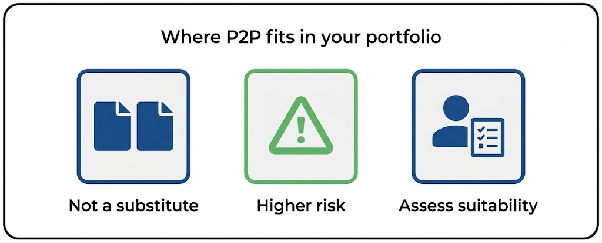
Image: Where P2P investing fits alongside ASB and EPF in a Malaysian portfolio.
P2P investing is not a substitute for EPF or ASB. It is a separate investment option with a different risk profile that some Investors may consider alongside their existing savings, depending on their financial circumstances and investment objectives.
- EPF: Primarily serves as a retirement savings scheme and should not be viewed as a like-for-like alternative to P2P investing.
- ASB: Offers a different investment structure and risk profile. Eligible Investors should assess its features and terms separately from those of P2P investments.
- P2P investing: Offers stated potential returns alongside a risk of default and no capital protection. Investors should commit only funds they can afford to lose and will not need before the Investment Note matures.
Repayment of P2P Investment Notes is not guaranteed, regardless of the assigned risk grade. These investments are not protected by PIDM or the CMCF.
The appropriate allocation depends on each Investor’s financial circumstances, risk tolerance and investment objectives. This article is intended for general informational purposes only and does not constitute personalised investment advice. Investors should consider their individual financial circumstances, risk tolerance and investment objectives before making investment decisions, and seek independent professional advice where appropriate.
As a risk-management measure, the Securities Commission Malaysia (SC) encourages retail Investors to limit their total investment exposure across P2P financing platforms to RM50,000 at any one time. Investors should carefully consider the risks before exceeding this amount.
For more on the factors that influence P2P returns, see What Affects Your P2P Investment Returns? Tenor, Risk Grade & Repayment.
Frequently asked questions about P2P investing vs ASB and EPF in Malaysia
Is P2P investing better than ASB for Malaysians?
P2P investing and ASB have different risk profiles, return structures and eligibility requirements. P2P Investment Notes offer stated potential returns alongside default risk and no capital protection, while ASB distributions are not guaranteed. ASB is generally available to eligible Bumiputera Investors. The appropriate choice depends on an Investor’s financial circumstances and investment objectives.
Can I use P2P investing instead of EPF for retirement savings?
No. EPF serves a statutory retirement savings function, with mandatory contributions applying to eligible employees under the relevant requirements. P2P investing is a separate investment option and should not be viewed as a replacement for retirement savings. Both products serve different purposes and carry different risk profiles.
What happens to my P2P investment if the platform shuts down?
Investor funds are held in segregated trust accounts through Universal Trustee (Maybank Trustees Berhad), separate from microLEAP’s own funds. If microLEAP ceases operations, servicing obligations are transferred to an appointed independent third party, in accordance with the applicable arrangements and regulatory requirements. However, these safeguards do not eliminate the risk of an Issuer defaulting or guarantee the recovery of invested capital.
Is P2P investing in Malaysia Shariah-compliant?
Investors seeking Shariah-compliant investments can select designated Shariah-compliant Investment Notes on microLEAP. These Notes use a Commodity Murabahah structure via a Tawarruq arrangement and are reviewed by Masryef Shariah Advisory. Conventional Investment Notes are not Shariah-compliant.
For more information, see Is P2P Investing Shariah-Compliant? Shariah-Compliant Financing in Malaysia Explained.
Can non-Bumiputera Malaysians invest through P2P financing platforms?
Yes. microLEAP is open to eligible Malaysian and non-Malaysian individual and corporate Investors, subject to registration and due diligence requirements, without ethnicity- or religion-based restrictions. This differs from ASB, which is generally available to eligible Bumiputera Investors. However, P2P investing carries investment risks and should not be treated as a conventional savings account.
How does P2P investing risk compare with EPF?
P2P investing carries the risk of Issuer default, which may result in partial or total loss of invested capital. EPF operates under a statutory retirement savings framework. Its Conventional Account has a minimum annual dividend rate of 2.50%, while the Shariah Account's dividend rate depends on actual investment performance, with no guaranteed minimum. P2P Investment Notes are not capital-guaranteed and are not protected by PIDM or the CMCF.
Conclusion
P2P investing, ASB and EPF serve different purposes, with distinct return structures, risk profiles, liquidity and eligibility requirements. While P2P Investment Notes offer stated potential returns, these are not guaranteed and come with default risk and no capital protection.
EPF serves a retirement savings function, and P2P investing should not replace mandatory EPF contributions or adequate retirement planning. ASB, where eligible, offers a different investment structure and risk profile.
P2P Investment Notes are not protected by Perbadanan Insurans Deposit Malaysia (PIDM) or the Capital Market Compensation Fund (CMCF), regardless of the Note’s assigned risk grade. The appropriate allocation depends on each Investor’s financial circumstances, risk tolerance and investment objectives. microLEAP does not determine investment suitability.
All investments carry risk. Investors should review microLEAP’s Terms and Conditions and applicable risk disclosures before committing funds.
Regulatory and advertising disclosures
This advertisement has not been reviewed by the Securities Commission Malaysia.
microLEAP PLT is registered with the Securities Commission Malaysia as a Recognised Market Operator to operate a P2P financing platform. Registration with the SC does not constitute a recommendation or endorsement by the SC of microLEAP, its products, services or any Investment Note.
P2P Investment Notes are not capital-guaranteed or protected by PIDM. Investors may experience delayed repayment, Issuer default, and partial or total loss of principal. Returns are not guaranteed.