
Key takeaways
- P2P investing is open to first-time Investors in Malaysia, but it is an investment product, not a savings account. Capital is at risk and returns are not guaranteed.
- Many of the mistakes made by first-time P2P Investors are avoidable and stem from how they approach diversification, returns, risk and platform selection.
- Six common mistakes include treating P2P investing like a savings product, expecting quick or guaranteed returns, concentrating funds in a single Investment Note, chasing the highest profit rate, overlooking risk ratings and financing tenors, and failing to check whether a platform is properly registered.
- In Malaysia, P2P financing platforms are operated by Recognized Market Operators (RMO) registered with the Securities Commission Malaysia (SC).
- Investors on microLEAP can invest from as little as RM10 per Investment Note, subject to eligibility requirements and applicable platform terms.
Introduction
P2P investing has become an increasingly accessible way for individuals in Malaysia to participate in financing opportunities for businesses. For first-time Investors, however, the more important question is often not simply how to get started, but whether they understand the risks involved and what to look for when choosing a platform.
microLEAP is a P2P financing platform registered with the Securities Commission Malaysia (SC) as a Recognized Market Operator (RMO).
As with any investment, there are risks involved. For first-time Investors, some of the most common pitfalls arise not from the P2P financing structure itself, but from decisions made before and after investing, from selecting a platform and assessing risk to managing diversification and expectations around returns.
This article examines six common mistakes first-time P2P Investors should be aware of and the considerations that may help them make more informed investment decisions.
Is P2P investing suitable for a first-time Investor in Malaysia?
P2P investing is accessible to first-time Investors in Malaysia, but it should not be viewed as a savings product. As with other forms of investment, capital is at risk and returns are not guaranteed.
P2P investing allows individuals to provide financing to businesses through an online platform. Investors may earn returns when the financing is repaid according to the agreed terms. The businesses raising funds through the platform are generally referred to as Issuers.
One of the features that may make P2P investing accessible to new Investors is the relatively low minimum investment amount available on some platforms. This allows an Investor to begin with a smaller amount, gain familiarity with the investment process and potentially spread their capital across multiple Investment Notes.
However, a lower minimum investment does not mean lower investment risk.
An Issuer may repay financing late or, in some circumstances, fail to repay. Where an Issuer defaults, an Investor may lose part or all of the capital invested in the relevant Investment Note. The actual outcome may depend on factors including the Issuer's financial position, the terms of the financing and any recovery or enforcement processes available.
For this reason, the suitability of P2P investing ultimately depends on an individual's understanding of the risks, investment objectives, financial circumstances and ability to tolerate potential losses.
First-time Investors should therefore approach P2P investing as an investment activity rather than as an alternative to keeping money in a savings account.
What are the most common mistakes first-time P2P Investors make?
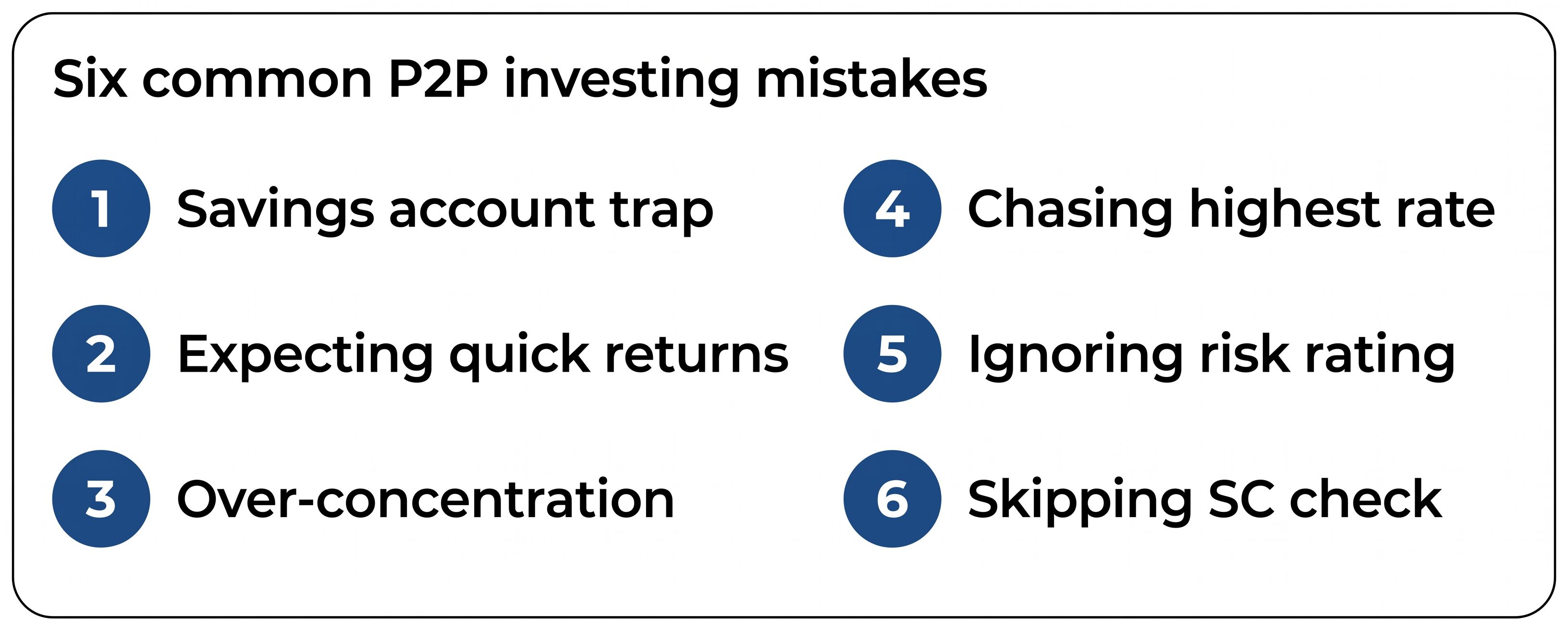
Image: Six common mistakes first-time P2P Investors make.
For first-time Investors, the most common mistakes in P2P investing tend to fall into six recurring habits: treating P2P like a savings product, expecting quick or guaranteed returns, concentrating funds in a single Investment Note, chasing the highest profit rate, overlooking risk ratings and tenors, and failing to check a platform's regulatory status.
Treating P2P like a savings account
One of the most common mistakes is treating a P2P investment in the same way as a savings account or fixed deposit.
P2P investments are not deposits. Capital is at risk. An Issuer may miss a repayment, make a late repayment or default altogether, which means an Investor may not recover the full amount invested.
The distinction is important: P2P is an investment, not a savings product.
Investors should therefore consider P2P investments based on their investment objectives and risk tolerance, rather than treating the funds as cash that can be expected to remain readily available or fully protected.
Expecting quick or guaranteed returns
Some first-time Investors may expect returns from P2P investments to arrive quickly and consistently from the outset.
In practice, repayments on a P2P Investment Note are made by the Issuer over the stated tenor of the Note, typically on a monthly basis. The returns received by an Investor depend on the Issuer making those repayments on time and in full.
If an Issuer misses a scheduled payment, the corresponding repayment and return may be delayed. If the Issuer defaults, the Investor may not receive the expected return and may also lose part or all of the capital invested.
P2P investing therefore requires an understanding of the repayment timeline and the possibility of delays or defaults. Unlike a savings product, the outcome depends on the Issuer's repayment performance.
Concentrating funds in one Investment Note
Putting all available funds into a single Investment Note amplifies the impact of any one default.
Spreading funds across several Investment Notes, sectors, tenors and risk ratings may reduce the effect that any one Issuer's repayment performance has on an overall portfolio. If one Note is delayed or defaults, the others continue independently.
Diversification may lower exposure but does not eliminate risk. Capital remains at risk across every Note an Investor holds.
Chasing the highest profit rate
Selecting an Investment Note based on the highest advertised profit rate, without reviewing anything else, may expose an Investor to more risk than intended.
A higher profit rate generally reflects higher credit risk, not better value. It indicates that the Issuer carries a higher likelihood of repayment difficulty based on the platform's credit assessment. The higher return is compensation for that additional risk.
The risk rating, tenor and Issuer profile are relevant alongside the profit rate, not separate from it.
Overlooking the risk rating and tenor
Investing in a Note without reviewing its risk rating or tenor may leave an Investor with more exposure than understood going in.
microLEAP assigns a risk rating to each Investment Note, Low, Medium or High, based on the Issuer's credit assessment. The risk rating provides an indication of the assessed level of credit risk associated with the Issuer, but it does not mean that an investment is risk-free. A Low risk rating does not mean there is no risk, and Investors may still face the possibility of delayed payments, default or loss of capital.
Each Note also carries a stated tenor, which is the period over which the Issuer is expected to repay. The tenor indicates how long an Investor’s funds may be committed and, together with the risk rating, may affect the overall risk profile of the investment.
Both the risk rating and the tenor are therefore worth reviewing carefully before committing to any Note. Understanding these factors can help Investors make a more informed assessment of whether an investment is appropriate for their circumstances and risk tolerance.
Not checking the platform's registration
Investing through a platform without first verifying its regulatory status leaves an Investor with limited recourse if things go wrong.
In Malaysia, only platforms registered with the Securities Commission Malaysia (SC) as a Recognised Market Operator (RMO) may legally operate a P2P financing platform. SC registration requires the platform to meet specific obligations, including holding Investor funds in segregated trust accounts.
Investors can verify a platform’s regulatory status by checking the SC register of RMOs. microLEAP PLT is registered with the SC as a RMO.
However, registration should be viewed as a baseline regulatory check rather than an endorsement or guarantee by the SC. It does not remove the investment risks associated with participating in a Note, nor does it guarantee the performance or repayment of any investment.
For a closer look at what SC regulation means in practice, read: Is P2P Financing Safe in Malaysia? SC Regulation Explained.
How can a first-time Investor start on the right footing?
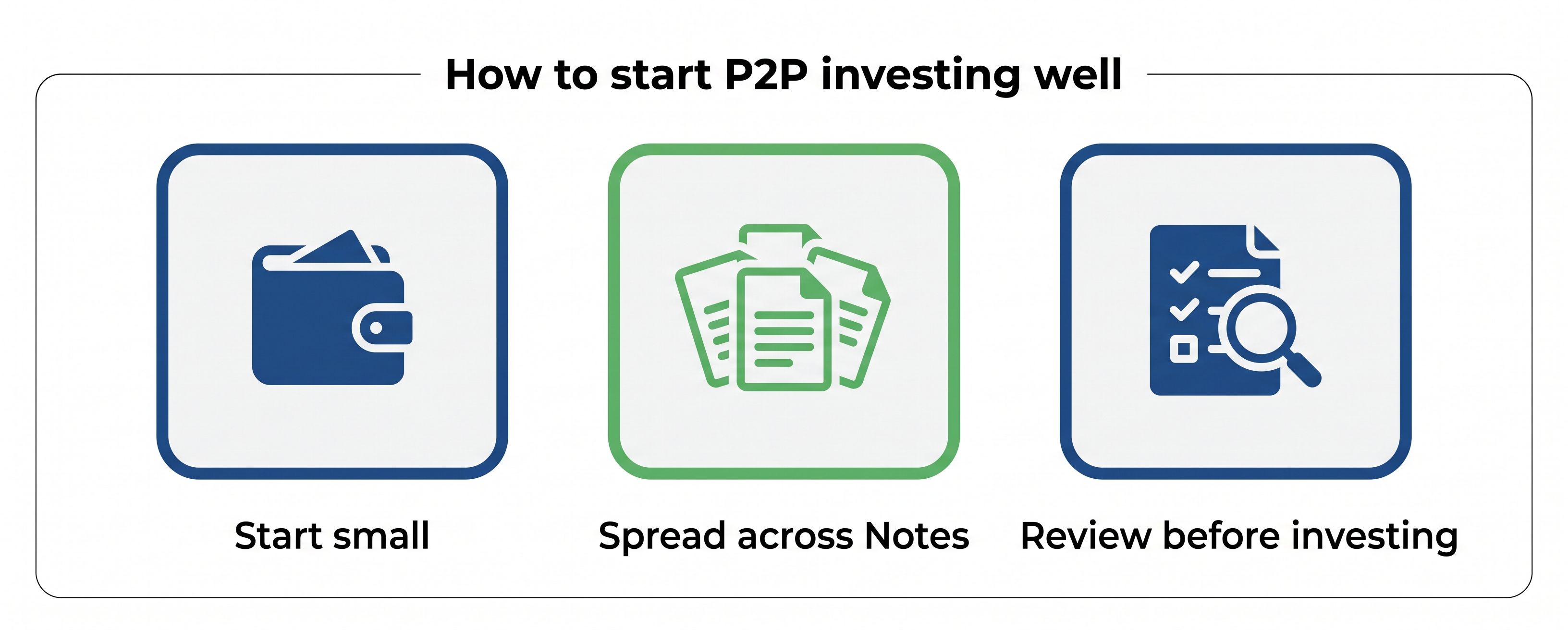
Image: How a first-time Investor can start P2P investing in Malaysia.
Starting with a small amount and diversifying across several Investment Notes can help Investors gain familiarity with the platform while limiting the amount committed to any single Note.
The minimum investment on microLEAP is RM10 per Investment Note, subject to eligibility requirements and applicable platform terms. This allows an Investor to spread a smaller amount across multiple Investment Notes and gain experience with how the platform works before considering whether to commit additional funds.
Before investing in any Note, Investors should review the Fact Sheet and information disclosed for the investment, including the profit rate, tenor, risk rating and Issuer information. These details are made available before funds are committed and can help Investors assess the terms and risks of each Note.
For a step-by-step guide to getting started with P2P investing, see How to Start Investing in P2P with as Little as RM10: A Beginner's Guide.
For a practical framework for comparing P2P platforms, including SC registration, default rates, track record, fees and risk disclosures, see How to Choose a P2P Platform in Malaysia: A Checklist.
Frequently asked questions about P2P investing for first-time Investors in Malaysia
How much should a beginner invest in P2P in Malaysia?
There is no fixed amount that is appropriate for every Investor. A sensible starting point is an amount the Investor can afford to lose without affecting their financial commitments.
Investors may also consider spreading their investments across multiple Investment Notes, sectors, tenors and risk ratings rather than concentrating a larger amount in a single opportunity. Diversification can help reduce concentration risk, although it does not eliminate the risk of loss.
What is the minimum amount to start P2P investing on microLEAP?
The minimum investment is RM10 per Investment Note, subject to eligibility requirements and applicable platform terms.
Can a first-time Investor lose money in P2P investing?
Yes. If an Issuer defaults, an Investor may experience a partial or total loss of the capital invested in that Note. P2P investments are not protected by Perbadanan Insurans Deposit Malaysia (PIDM), any deposit insurance scheme, or the Capital Market Compensation Fund (CMCF).
Investors should therefore consider the potential for loss before committing funds and review the information disclosed for each Investment Note.
Is P2P investing a good investment for beginners in Malaysia?
Whether P2P investing is appropriate depends on an individual's financial circumstances, risk tolerance and investment objectives. P2P investing can provide potential returns, but capital is at risk and returns are not guaranteed.
First-time Investors should understand how P2P investing works, consider the risks involved and review the terms and disclosures of each Investment Note before committing funds.
What happens to my money if a P2P platform shuts down?
Investor funds are held separately from the platform operator's own funds. SC-registered P2P platforms are required to maintain Investor funds in segregated trust accounts under an independent trustee.
For microLEAP, the trustee is Universal Trustee (Maybank Trustees Berhad). If the platform operator ceases business, the trustee's role includes continuing to administer outstanding Investment Notes in accordance with the applicable terms and arrangements.
Investors should review the relevant platform and investment documentation for details on how outstanding Notes are administered in such circumstances.
Conclusion
For first-time P2P Investors, understanding the structure of the investment is only part of managing risk. The decisions made before and after investing can also affect the level of exposure.
Treating P2P as a savings product, expecting guaranteed returns, concentrating investments in a single Investment Note, pursuing the highest available rate, overlooking risk ratings or tenors, or failing to check a platform’s regulatory status can increase an Investor’s exposure to risk. These are considerations that can be addressed by understanding how P2P investing works and reviewing the information available before committing funds.
All investments carry risk, and P2P investments can result in a partial or total loss of capital. Investors should review microLEAP's terms and conditions, including the applicable risk disclosures, before investing.
Regulatory and advertising disclosures
This advertisement has not been reviewed by the Securities Commission Malaysia.
microLEAP PLT is registered with the Securities Commission Malaysia as a Recognised Market Operator to operate a P2P financing platform. Registration with the SC does not constitute a recommendation or endorsement by the SC of microLEAP, its products, services or any Investment Note.
P2P Investment Notes are not capital-guaranteed or protected by PIDM. Investors may experience delayed repayment, Issuer default, and partial or total loss of principal. Returns are not guaranteed.